


-720x400.jpg)

What Is a Baler?
A baler is a recycling machine designed to compress loose recyclable materials into dense, manageable bales.
Instead of storing large volumes of loose waste, businesses use balers to reduce material volume and make transportation and storage more efficient.
Common materials processed by balers include:
- Cardboard
- Waste paper
- Plastic bottles
- Plastic film
- Soft plastics
- Aluminium cans
- Industrial recyclable waste
For Australian businesses facing increasing labour and logistics costs, a baler can significantly improve recycling efficiency.
How Does a Baler Work?
A horizontal baler uses hydraulic force to compress recyclable materials into compact bales.
The working process includes:
1. Material Feeding
Waste materials are loaded into the hopper through manual feeding or an automatic conveyor system.
For high-volume operations, automatic feeding reduces labour requirements and keeps production continuous.
2. Compression
The hydraulic ram pushes materials into the compression chamber.
High-pressure compression creates dense, stable bales that are easier to store and transport.
3. Automatic Tying
When the preset bale length is reached, the automatic tying system secures the bale with wire.
This allows continuous production without manual tying.
4. Bale Discharge
The finished bale is automatically pushed out and ready for storage, transport or sale.
How Much Does a Baler Cost in Australia?
The cost of a baler depends on several factors:
Machine Type
Small vertical balers are suitable for lower volumes.
Automatic horizontal balers are designed for businesses processing several tonnes of material per hour.
Material and Capacity
A cardboard recycling plant processing 10–20 tonnes per hour requires a different machine compared with a small warehouse producing several tonnes per week.
Important factors include:
- Material type
- Daily volume
- Required bale size
- Automation level
Long-Term Operating Cost
The cheapest machine is not always the lowest-cost solution.
Australian operators should also consider:
- Labour requirements
- Energy efficiency
- Maintenance frequency
- Spare parts availability
- Machine lifespan
How to Choose an Automatic Horizontal Baler?
1. Check Your Daily Material Volume
Before purchasing, determine:
- How many tonnes per day do you process?
- Is the material generated continuously?
- Do you need automatic feeding?
For operations above approximately 2 tonnes per hour, an automatic horizontal baler is usually the more efficient choice.
2. Choose the Right Bale Size
Bale dimensions affect transport efficiency.
Larger and denser bales mean:
- More material per truck/container
- Lower transport cost per tonne
- Easier handling
The ideal bale size depends on your downstream buyers and logistics requirements.
3. Look at Hydraulic System Reliability
A baler used in Australia needs to handle demanding working conditions.
Important features include:
- Stable hydraulic performance
- Reliable cylinders
- Efficient cooling system
- Continuous operation capability
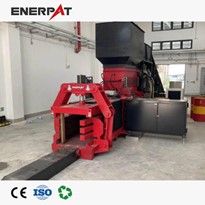
ENERPAT horizontal balers use a European-designed hydraulic system with high-quality components, designed for industrial recycling applications.
4. Consider Labour Saving
Labour costs are an important factor for Australian businesses.
Automatic horizontal balers help reduce labour requirements through:
- Automatic feeding
- Automatic compression
- Automatic tying
- Automatic bale discharge
ENERPAT Automatic Horizontal Baler for Australian Recycling Businesses
The ENERPAT Auto Tie Horizontal Baler is designed for high-volume recycling operations requiring reliable and efficient waste handling.
It processes:
- Cardboard
- Waste paper
- Plastic film
- PET bottles
- Industrial recyclable waste
- Aluminium and steel cans
With capacity up to 20 tonnes per hour, it helps recycling businesses produce high-density bales while reducing storage and transportation costs.
Why Choose ENERPAT Horizontal Baler?
1. High-Density Bale Production
The three-way compression system improves bale density and shape.
Benefits:
- Stable bale structure
- Easier transportation
- Better storage efficiency
2. Automatic German Tying Technology
The automatic tying system ensures every bale is securely tied.
Benefits:
- Less manual labour
- Faster production
- Consistent bale quality
3. Designed for Continuous Operation
Australian recycling facilities often require long working hours.
ENERPAT balers feature:
- Industrial hydraulic system
- Cooling system for long operation
- Reliable electrical components
4. Flexible Bale Sizes
Available bale dimensions include:
- 500×500 mm
- 720×720 mm
- 1100×1100 mm
- 1100×1250 mm
Bale size can be selected according to customer requirements and transportation needs.
Final Thoughts: Choosing the Right Baler for Your Business
A horizontal baler is a long-term investment.
When comparing machines, look beyond the purchase price and consider:
- Production capacity
- Bale density
- Labour savings
- Maintenance requirements
- Reliability
- After-sales support
For Australian recycling companies handling high volumes of recyclable materials, an automatic horizontal baler can improve efficiency, reduce operating costs and maximise the value of recovered materials.


-160x160-state_article-rel-cat.png)


-160x160-state_article-rel-cat.png)

-205x205.jpg)
-205x205.jpg)
-205x205.jpg)
-205x205.jpg)
-205x205.jpg)


(1)-205x205.jpg)


-205x205.jpg)
(1)-205x205.jpg)

-205x205.jpg)
-205x205.jpg)
