
Key takeaways
| Factor | Guidance |
|---|---|
| Entry-level price (AUD) | $4,000–$8,000 for light-duty and occasional use |
| Mid-range price (AUD) | $8,000–$15,000 for regular warehouse stacking operations |
| Industrial price (AUD) | $15,000–$25,000+ for heavy-duty or high-lift configurations |
| Typical lift height range | 1,600mm–5,500mm depending on mast configuration |
| Load capacity range | 1,000–2,000 kg for most warehouse models |
| Key cost drivers | Lift height, mast type, load capacity, battery technology |
| Forklift licence requirement | Not required for most walkie models — confirm with state WHS regulator |
| Annual maintenance cost | $300–$600 for servicing and wear components |
Why buyers choose walkie straddle stackers
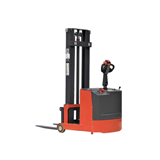
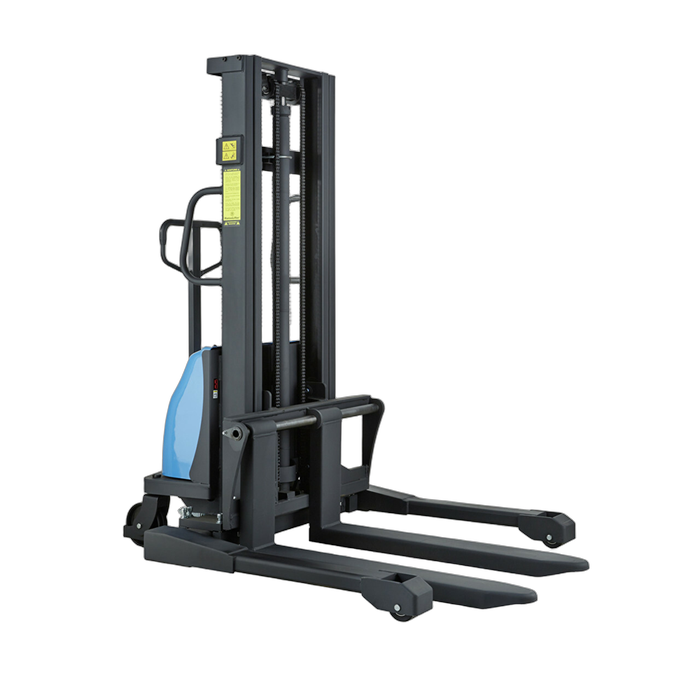
A walkie straddle stacker is a battery-powered pedestrian-operated machine designed to lift pallets onto racking. Unlike a pallet jack — which moves loads horizontally at ground level — a straddle stacker raises loads vertically, with forks that extend upward along a mast. The operator walks alongside the machine rather than riding on it, keeping training requirements and licence obligations simpler than a sit-down forklift.
They fill the gap between a pallet jack and a counterbalance forklift: more capable than ground-level pallet handling equipment, but without the cost, footprint or licence requirements of a full forklift. They work particularly well where lift heights stay below 5.5 metres and aisles are too tight for larger equipment.
Operations that standardly run walkie straddle stackers include:
- Small to mid-size warehouses with low-to-mid-level racking
- Retail stockrooms with vertical storage
- Cold storage facilities where compact equipment is preferred
- Food and beverage operations with tight aisle configurations
- Manufacturing plants managing raw material or finished goods storage
Is this guide for you? If you're deciding whether a walkie straddle stacker suits your operation, comparing it against other lifting options, or shortlisting suppliers — this guide gives you what you need to choose confidently.
Product types / configurations
| Type | Lift Height | Load Capacity | Best For |
|---|---|---|---|
| Fixed mast | Up to 1,600mm | 1,000–1,500 kg | Truck loading, low-level racking |
| Single telescopic mast | 2,500–3,500 mm | 1,000–1,500 kg | Standard racking up to 3 levels |
| Full free-lift mast | 3,000–5,500 mm | 1,000–2,000 kg | High-bay racking, containers, height-restricted facilities |
| Powered straddle stacker | 3,000–5,500 mm | 1,500–2,000 kg | Regular high-lift, heavier loads |
Fixed mast models are the entry point and suit operations that only need low-level lifting. Before purchasing, measure your highest racking beam plus pallet height plus 150–200mm clearance — that is your actual minimum lift requirement, not the racking height alone.
Telescopic mast models cover most standard Australian warehouse pallet racking up to around 3.5 metres and are the most common configuration for small to mid-size operations.
Full free-lift mast models are essential where door or racking clearances are low — the inner mast rises before the outer extends, keeping the overall machine height compact until higher lift is needed. If you're loading containers, this is the configuration you need.
Key specifications buyers should evaluate
| Specification | Typical Range | Buyer Consideration |
|---|---|---|
| Maximum lift height | 1,600–5,500mm | Always verify capacity at your working height — rated capacity at ground level is not the same as at 4 metres. |
| Load capacity | 1,000–2,000 kg | Capacity reduces significantly as the mast extends. Check the load chart at your actual lift height before specifying. |
| Straddle leg width | 540–1,200mm adjustable | Must suit your pallet width. Adjustable legs add flexibility if you handle multiple pallet formats. |
| Mast type | Fixed / telescopic / full free-lift | Measure your tightest clearance point — doorways, racking bays, container openings — before selecting mast type. |
| Battery technology | Lead-acid or lithium-ion | Lithium-ion adds $2,000–$4,000 upfront but eliminates maintenance and suits multi-shift and cold storage use. |
| Aisle width requirement | 2,000–2,500mm typical | Narrower than a counterbalance forklift but still needs adequate turning room. Walk your tightest aisle with the spec sheet before buying. |
Technology or configuration options
| Factor | Lead-Acid Battery | Lithium-Ion Battery |
|---|---|---|
| Purchase price premium | None — standard | $2,000–$4,000 higher |
| Lifespan | 3–5 years | 5–8 years |
| Charge time | 6–8 hours | 1–3 hours |
| Opportunity charging | Not recommended | Fully supported |
| Annual maintenance | Watering and inspection required | None |
| Replacement cost | $600–$1,500 | $1,500–$3,500 |
Choose lead-acid when the stacker runs one shift with reliable overnight charging and budget is tight. It is proven technology — just factor in one battery replacement within 3–5 years and maintain a disciplined charge cycle.
Choose lithium-ion for multi-shift operations, short charging windows, or cold storage environments. Lead-acid performance degrades noticeably below 10°C, making lithium-ion the practical default for any refrigerated facility.
Costs in Australia
| Category | Price Range (AUD, 2026) | Typical Configuration |
|---|---|---|
| Entry-level fixed mast | $4,000–$8,000 | Fixed mast, 1,000 kg, basic controls |
| Mid-range telescopic | $8,000–$15,000 | Single telescopic mast, 1,000–1,500 kg |
| Industrial full free-lift | $15,000–$25,000+ | Full free-lift, 1,500–2,000 kg, lithium-ion option |
| Used / refurbished | $3,000–$12,000 | Verify mast chain and battery condition before purchasing |
Annual servicing runs $300–$600 covering mast chain lubrication, hydraulic seals, drive wheels and brakes. Mast chains are the most maintenance-critical component — inadequate lubrication causes chain stretch and eventual failure, which is both a safety risk and an expensive repair on any unit lifting regularly above 3 metres. Battery replacement adds $600–$1,500 for lead-acid at years 3–5, or $1,500–$3,500 for lithium-ion at years 5–8.
Australian compliance requirements
- Walkie straddle stackers are classified as plant under the Work Health and Safety Regulations 2017 — maintenance, inspection and operator training obligations apply
- Most walkie models do not require a High Risk Work Licence — the operator walks alongside and is not elevated with the load
- If the operator rides on or is elevated with the load, a High Risk Work Licence may apply — confirm with your state WHS regulator
- Equipment must be maintained per manufacturer specifications and AS 2359 (industrial trucks standard)
- Mast chains must be inspected at manufacturer-specified intervals — typically every 500 operating hours or annually
- Lead-acid charging areas require ventilation compliance under WHS regulations
- Racking must be rated for loads placed by the stacker — verify load ratings before introducing higher-capacity equipment
Supplier comparison checklist
| Factor | What to Ask |
|---|---|
| Capacity at working height | What is the rated capacity at my actual lift height — not ground-level maximum? |
| Mast recommendation | Based on my racking height and clearances, which mast type do you recommend? |
| Straddle leg compatibility | Do the legs suit my pallet width, and are adjustable legs available? |
| Free-lift specification | What is the collapsed mast height, and does it clear my lowest doorway or racking bay? |
| Battery and charger | Is the charger included in the quoted price, and what type is the battery? |
| Mast chain service | What is the chain inspection interval, and is it covered under a service contract? |
| State service coverage | Do you have technicians in my state, and what is the breakdown response time? |
| Spare parts | Are chains, seals and drive wheels held in-country? |
| Warranty | Does the warranty cover the mast assembly and hydraulics separately from the chassis? |
Frequently asked questions
How much does a walkie straddle stacker cost in Australia? Pricing runs from $4,000 for basic fixed mast models to $25,000+ for industrial full free-lift configurations with lithium-ion batteries. Most operations running standard warehouse racking land in the $8,000–$15,000 range. Always confirm whether the charger is included — some suppliers price it separately, adding $400–$1,000 to the total.
Do I need a forklift licence to operate one? Most walkie straddle stackers don't require a High Risk Work Licence because the operator walks alongside and isn't elevated with the load. Some configurations sit in a grey area depending on use and state. Confirm the specific model's classification with your state WHS regulator — and regardless of licence status, documented operator training is mandatory under WHS obligations.
What lift height do I need? Don't measure the racking height — measure the highest beam, add pallet height, then add 150–200mm clearance. That total is your minimum. If you're planning to extend racking in the next few years, spec to your future configuration now rather than upgrading equipment later.
How does lift height affect load capacity? Rated capacity on the spec sheet is at ground level — it drops as the mast extends. A unit rated at 1,500 kg at ground level may only safely handle 1,000–1,200 kg at maximum lift height. Always check the load chart at your actual working height before specifying.
Lead-acid or lithium-ion — which should I choose? For a single-shift operation with overnight charging, lead-acid is cost-effective and reliable. For multi-shift use, cold storage, or constrained charging windows, lithium-ion is the better long-term choice. The $2,000–$4,000 upfront premium is typically recovered within 4–5 years through lower maintenance and avoided battery replacement.
What ongoing maintenance is required? Budget $300–$600 annually for servicing. The critical item is mast chain lubrication and inspection — neglect here leads to chain stretch, failure and a repair bill that dwarfs the cost of a service contract. Battery replacement is the other major cost: $600–$1,500 for lead-acid at years 3–5, or $1,500–$3,500 for lithium-ion at years 5–8.
Summary
- Pricing runs $4,000–$25,000+ — most standard warehouse applications land between $8,000 and $15,000
- Always check the load chart at your actual working height — rated capacity at ground level will be higher than at your racking height
- Full free-lift mast is essential for containers or low-clearance environments
- Most walkie models don't require a forklift licence — but confirm the specific model with your state WHS regulator
- Lithium-ion is the default choice for cold storage, multi-shift operations and short charging windows
- Mast chain maintenance is the single most important servicing obligation — don't skip it
Ready to source your walkie straddle stacker?
Don't waste time chasing individual suppliers. IndustrySearch gives you direct access to verified Australian walkie straddle stacker suppliers — compare models, specs and pricing in one place, then request quotes from suppliers best matched to your operation.
- Compare models — filter by capacity, configuration and region
- Request quotes — contact multiple verified suppliers with a single enquiry
- Contact suppliers directly — speak to specialists who service your state
Compare Walkie Straddle Stackers on IndustrySearch Now ?

-160x160-state_article-rel-cat.png)




-160x160-state_article-rel-cat.png)