
Key takeaways
- New flow wrapper prices (2026 AUD): entry semi-auto $15,000-$35,000, mid-range servo $40,000-$80,000, high-speed automated $80,000-$200,000+.
- Drive type sets your price and speed ceiling: mechanical cam-driven machines cap at 60-80 packs/minute, servo-driven machines reach 150-300+ packs/minute with faster changeovers.
- If your product is a single solid item under 500g (bars, biscuits, soap) → entry-level mechanical. If products vary in size or the line runs multiple SKUs per shift → servo-driven with tool-free changeover.
- Film type drives ongoing cost: polypropylene at $0.01-$0.02 per wrap vs laminated barrier films at $0.03-$0.05 per wrap. MAP-capable wrappers add $10,000-$30,000 for gas flushing.
- Food-contact compliance: all film and machine surfaces in contact with food must meet FSANZ food-grade requirements. Pharmaceutical applications require GMP-validated equipment.
- The most common mistake is underspecifying changeover speed - a mechanical wrapper changing SKUs 4-6 times per shift can lose 2-3 hours of production per day vs a servo machine with 5-minute tool-free changeover.
- Flow wrappers from verified Australian suppliers are available on IndustrySearch.
Introduction
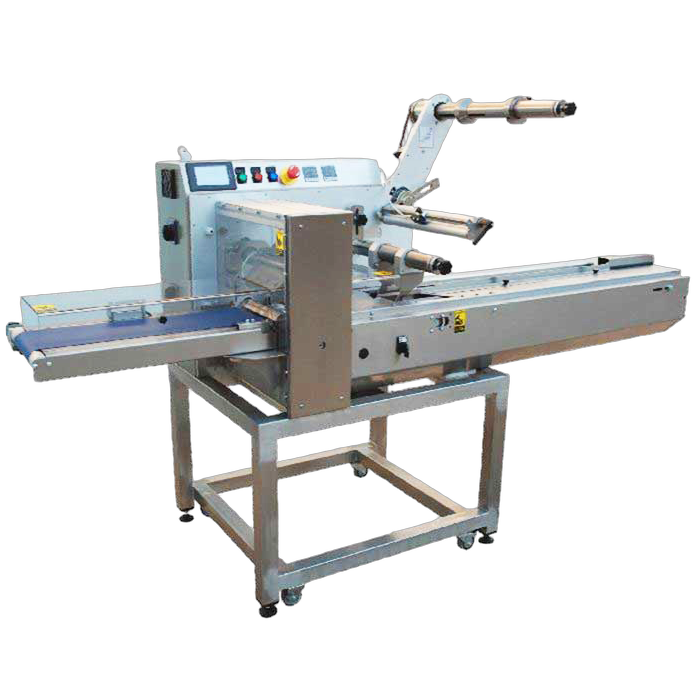
A flow wrapper (also called a horizontal form fill seal machine) wraps individual products in a continuous sheet of film, sealing on three sides to produce a finished pillow pack, fin-seal or modified atmosphere package. In the Australian market in 2026, flow wrappers are the standard primary packaging solution for food manufacturers, bakeries, confectionery producers, snack lines and non-food operations packaging bars, soaps, medical devices and hardware components. Demand is driven by the ongoing shift from contract packing to in-house wrapping as Australian manufacturers look to control per-unit packaging cost, reduce lead times and maintain tighter quality control over shelf presentation.
This guide walks you through the three decisions that set your price: drive type, speed class and film compatibility. If you are comparing supplier quotes, get quotes for flow wrappers on IndustrySearch to benchmark pricing from multiple verified suppliers. For a comparison between flow wrapping and vertical form fill seal, see the flow wrapper vs VFFS comparison (published separately in this series).
Operations that typically invest in flow wrappers:
- Bakeries and confectionery manufacturers wrapping biscuits, bars, cakes and snack foods
- Fresh food producers wrapping cheese portions, fresh produce trays and protein packs (MAP)
- Pharmaceutical and medical device manufacturers wrapping blister packs, syringes and kits
- Hardware and industrial product manufacturers wrapping components, fasteners and small parts
- Contract packers and co-packers running multiple SKUs across short and long runs
Choose your drive type and speed class
Before specifying anything else, confirm which drive type and speed class your production volume and SKU mix require. Your choice here sets your price bracket, changeover speed and the throughput ceiling for the life of the machine.
Type | Speed | Price Range (AUD) | Best For |
|---|---|---|---|
Entry semi-auto (mechanical cam) |
20-80 packs/min |
$15,000-$35,000 |
Single-product lines, low-volume, fixed pack size, manual infeed |
Mid-range servo |
60-200 packs/min |
$40,000-$80,000 |
Multi-SKU lines, frequent changeovers, automatic infeed, print registration |
High-speed automated |
150-300+ packs/min |
$80,000-$200,000+ |
High-volume production, integrated line with checkweigher and case packer, MAP capability |
If your line runs a single product at a fixed size below 80 packs per minute with no changeover requirement, an entry-level mechanical wrapper keeps capital under $35,000. If you run 3+ SKUs per shift or need speeds above 100 packs per minute, servo-driven is the minimum specification - the tool-free changeover alone saves 2-3 hours of production per day compared to mechanical adjustment.
Evaluate the key specifications
With your drive type confirmed, these are the specifications that determine whether a given flow wrapper fits your product and line.
Specification | Typical Range | Buyer Consideration |
|---|---|---|
Max product width |
50-350 mm |
Measure your widest product including any tray or insert - the wrapper must accommodate the full cross-section |
Max product height |
10-150 mm |
Tall or irregular products may require box-motion jaws rather than rotary crimping jaws |
Film width range |
100-600 mm |
Must cover the product's full circumference plus seal overlap. Wider film = higher per-wrap cost |
Seal type |
Fin seal, lap seal or hermetic crimp |
Fin seal is standard for most food. Hermetic crimp required for MAP and extended shelf life |
Film compatibility |
OPP, BOPP, polyethylene, laminated, paper-based |
Confirm the wrapper handles your current film type and any sustainable film you plan to transition to |
Changeover time |
5 minutes (servo, tool-free) to 30-45 minutes (mechanical) |
Multiply changeovers per shift by changeover time - this is your daily production loss |
MAP capability |
Gas flush with hermetic seal |
Adds $10,000-$30,000 to purchase price - required for fresh meat, cheese and ready meals with extended shelf life |
Understand the full cost breakdown (2026 prices)
Purchase price is only part of the picture - most cost models that get rejected at approval stage have missed the running cost layer. Here is the full breakdown.
Category | Cost Range (AUD) | Typical Configuration |
|---|---|---|
New entry semi-auto |
$15,000-$35,000 |
Mechanical, single product, manual infeed, 20-80 ppm |
New mid-range servo |
$40,000-$80,000 |
Servo-driven, auto infeed, print registration, tool-free changeover |
New high-speed automated |
$80,000-$200,000+ |
Full line integration, MAP, checkweigher interface, 150-300+ ppm |
Used |
$10,000-$50,000 |
All types - price depends on hours, seal jaw condition and servo age |
Film cost per wrap |
$0.01-$0.05 |
OPP/BOPP at low end, laminated barrier and MAP films at high end |
Annual maintenance |
$3,000-$10,000 |
Seal jaw replacement, blade sharpening, belt wear, servo calibration |
Annual energy |
$1,500-$4,000 |
Single-shift operation, 8 hours/day |
Consumables (sealing jaws, blades) |
$1,000-$4,000/year |
Frequency depends on speed, film type and daily hours |
For a mid-range servo wrapper at $60,000 running 50,000 packs per day at $0.02 per wrap in film, the annual film cost alone is $250,000. The machine pays for itself against contract packing (typically $0.05-$0.10 per unit) within 3-6 months at this volume. Below 5,000 packs per day, the payback period extends to 12-24 months and contract packing may still deliver better value. Get quotes for flow wrappers to compare delivered pricing and film cost estimates from suppliers before finalising your business case.
Plan the asset - depreciation and financing
The ATO assigns an effective life of 10 years for packaging machinery. Under diminishing value, the depreciation rate is 20%. Under prime cost, it is 10%. The current instant asset write-off threshold of $20,000 (2026 financial year) covers entry-level semi-auto wrappers for eligible small businesses. Mid-range and high-speed units require standard depreciation or structured finance.
Chattel mortgage gives immediate ownership and GST recovery. For operations where production volume is unproven or contract-dependent, an operating lease limits capital exposure. Import lead times from European manufacturers (Italian flow wrappers are the most common in the Australian market) run 12-20 weeks, so factor delivery timing into your procurement schedule. Residual values at 8-10 years sit at 10-20% for well-maintained servo machines.
Evaluate suppliers
You are ready to go to market. Use this checklist to assess each supplier against the same criteria.
Factor | What to Ask |
|---|---|
Product trial |
Can you run your actual products through the wrapper before committing? Send product samples for a trial run. |
Delivered price |
Total delivered price including infeed, outfeed conveyor, installation and commissioning? |
Film compatibility |
What film types does the machine handle? Can it run recyclable or paper-based films? |
Changeover time |
What is the changeover time between SKUs? Is it tool-free? |
Warranty |
Warranty period for servo motors, seal jaws, control system and frame? |
Parts availability |
Are seal jaws, blades, belts and servo components Australian-stocked or imported to order? |
Service network |
Do you have service engineers in NSW and VIC? What is the breakdown response time? |
Line integration |
Can the wrapper integrate with your existing checkweigher, metal detector or case packer? |
Lead time |
Current delivery lead time for new units? Are ex-demo or refurbished machines available? |
Finance |
Does the supplier offer chattel mortgage, operating lease or rent-to-own? |
Frequently asked questions
How much does a flow wrapper cost in Australia?
New flow wrappers range from $15,000-$35,000 for entry-level semi-auto to $80,000-$200,000+ for high-speed automated lines with MAP capability. The primary price driver is drive type (mechanical vs servo) and speed rating.
At what volume does in-house flow wrapping beat contract packing?
At 10,000+ packs per day, a mid-range servo wrapper at $60,000 typically pays back within 3-6 months against contract packing rates of $0.05-$0.10 per unit. Below 5,000 packs per day, the payback period extends to 12-24 months and contract packing may remain more cost-effective.
What is the difference between mechanical and servo flow wrappers?
Mechanical cam-driven wrappers are simpler and cheaper ($15,000-$35,000) but cap at 60-80 packs/minute with 30-45 minute changeovers. Servo-driven wrappers ($40,000-$200,000+) offer higher speeds, 5-minute tool-free changeover and better seal consistency across variable product sizes.
Can a flow wrapper handle modified atmosphere packaging (MAP)?
Yes, but MAP requires a gas flushing system and hermetic sealing jaws, which add $10,000-$30,000 to the base machine price. MAP flow wrappers are the standard for fresh meat, cheese portions and ready meals requiring extended shelf life in the Australian market.
What compliance applies to flow wrappers used for food packaging in Australia?
All film and machine surfaces in contact with food must meet FSANZ food-grade material requirements. Machine guarding must comply with AS/NZS 4024 (safety of machinery). Pharmaceutical applications require GMP-validated equipment with full documentation and traceability.
What matters most
- Drive type (mechanical vs servo) sets your speed ceiling, changeover time and purchase price
- Film cost per wrap ($0.01-$0.05) is the largest ongoing expense - often exceeding the machine cost within 12 months at volume
- In-house wrapping pays back within 3-6 months at 10,000+ packs per day vs contract packing
- Changeover time is the most undervalued specification - 5-minute servo changeover vs 30-45 minutes mechanical saves 2-3 hours per day on multi-SKU lines
- MAP capability adds $10,000-$30,000 but is required for fresh food shelf life extension
- Food-contact compliance under FSANZ and machine guarding under AS/NZS 4024 apply to all food packaging applications
Most buyers shortlist 2-3 machines after running a product trial - if you are within 90 days of purchasing, start the comparison now.
Don't waste time contacting suppliers individually. IndustrySearch gives you direct access to verified Australian flow wrapper suppliers - where industrial buyers request and compare multiple quotes so they can buy with confidence.
- Get quotes for flow wrappers - contact multiple verified suppliers with a single enquiry
- Compare models - filter by speed, drive type and region
- Contact suppliers directly - speak to packaging specialists who service your state
→ Get and compare flow wrapper quotes now → industrysearch.com.au/buy/flow-wrapper


-160x160-state_article-rel-cat.png)