
Key takeaways
- Palletisers typically cost between $40,000 and $250,000+ in Australia, depending on automation level, throughput capacity and system configuration.
- Robotic palletisers are the fastest-growing solution, offering flexible handling of multiple product types and pallet patterns.
- Conventional layer palletisers deliver the highest throughput, often stacking 20–40+ cases per minute in large production facilities.
- Collaborative palletising robots (cobots) are designed for lower-volume operations and can often operate without extensive safety fencing.
- Throughput capacity, product stability and pallet pattern complexity are the main factors determining which palletiser type is suitable.
- Industries including food processing, beverage manufacturing, logistics and FMCG distribution commonly implement palletisers to automate end-of-line packaging.
- Most businesses invest in palletising automation when manual pallet stacking becomes a labour bottleneck or workplace safety concern.
Introduction
Palletisers are automated systems used to stack cartons, bags, containers or packaged products onto pallets for storage, transport or distribution. They are typically installed at the end of production or packaging lines, where products are prepared for shipment.
Manual pallet stacking can become inefficient and physically demanding as production volumes increase. Repetitive lifting also creates workplace safety risks and labour constraints, particularly in high-throughput manufacturing environments.
Automated palletising systems solve this problem by organising products into structured pallet loads quickly and consistently, reducing manual labour while improving production efficiency and shipping consistency.
Palletisers are widely used across industries such as:
- food and beverage manufacturing
- pharmaceutical packaging
- consumer goods production
- logistics and distribution centres
- agricultural processing
- building materials manufacturing
Selecting the correct palletiser configuration is important because system performance depends heavily on product type, packaging format, production speed and available floor space.
Types of palletisers
Several palletiser technologies are available depending on production speed, product characteristics and automation requirements.
| Palletiser Type | Typical Application | Key Advantages |
| Robotic palletiser | Flexible manufacturing and multi-product lines | Highly adaptable and programmable |
| Conventional layer palletiser | High-volume production lines | Extremely fast throughput |
| Collaborative robot palletiser | Small to medium operations | Lower cost and easier installation |
| High-level palletiser | Heavy-duty packaging environments | Handles large volumes and heavy loads |
| Low-level palletiser | Medium production environments | Compact footprint |
Robotic palletisers
Robotic palletisers use industrial robotic arms equipped with specialised grippers to pick products and place them onto pallets in programmed stacking patterns.
They are increasingly common because they offer:
- flexible handling of different product formats
- easy pallet pattern adjustments through software
- compact installation footprints
- integration with automated packaging lines
Robotic palletisers typically handle:
- cartons
- bags
- trays
- shrink-wrapped bundles
Throughput generally ranges from 8–20+ picks per minute, depending on product weight and robot configuration.
Conventional layer palletisers
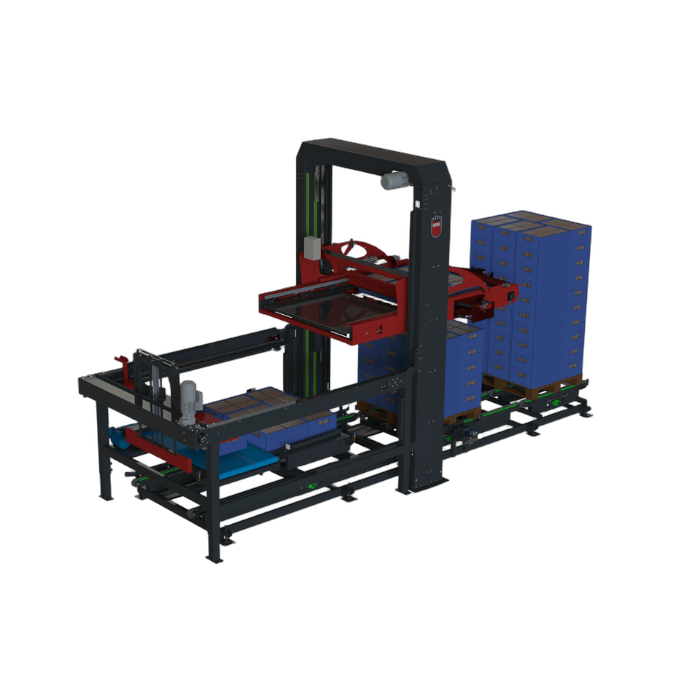
Layer palletisers stack entire layers of products simultaneously, rather than handling individual cartons.
They are commonly used in high-speed manufacturing environments, such as beverage bottling plants or large FMCG packaging lines.
Advantages include:
- extremely high throughput
- consistent pallet load stability
- efficient stacking of uniform packaging formats
Typical throughput capacity can exceed 25–40 cases per minute.
However, these systems usually require larger installation footprints and higher capital investment.
Collaborative robot (cobot) palletisers
Collaborative palletising robots are designed to operate alongside human workers with minimal safety barriers.
They are typically used in small to medium packaging operations where full industrial automation may not be necessary.
Key advantages include:
- lower equipment costs
- relatively quick installation
- flexible product handling
- smaller footprint compared with traditional palletisers
Cobot palletisers generally operate at lower speeds, typically 6–10 picks per minute.
High-level palletisers
High-level palletisers feed products into the system at an elevated level, allowing layers to be formed before being placed onto pallets.
These systems are common in industries such as:
- beverage bottling
- cement and construction materials
- bulk food packaging
They are typically used in large-scale manufacturing facilities with very high production throughput.
Low-level palletisers
Low-level palletisers feed products at floor level, making them easier to integrate with existing packaging lines.
They are often selected where:
- production speeds are moderate
- facility ceiling height is limited
- integration with existing conveyors is required
Key features and specifications
Several technical specifications determine palletiser suitability and operational performance.
| Specification | Typical Range |
| Throughput capacity | 6–40+ cartons per minute |
| Maximum payload | 10–200 kg per pick |
| Pallet size compatibility | Standard 1165 × 1165 mm or custom |
| Robot reach | 1.2–3 metres |
| Pallet height | Up to 2.2 metres |
| System footprint | 6–40 m² |
Throughput capacity
Throughput refers to how many cartons, bags or packaged products the palletiser can stack per minute.
Typical ranges include:
- cobot palletisers: 6–10 picks/min
- robotic palletisers: 8–20 picks/min
- layer palletisers: 25–40+ cases/min
Production speed is typically the most important factor when selecting palletising equipment.
Payload capacity
Payload capacity determines how heavy each product or bundle can be.
Examples include:
- small cartons: 5–15 kg
- beverage cases: 15–25 kg
- industrial bags: 25–50 kg
Heavier products may require heavy-duty robotic palletisers or specialised grippers.
Pallet pattern flexibility
Different products require specific stacking patterns to maintain pallet stability during transport and storage.
Robotic palletisers provide the most flexibility because pallet patterns can be modified through programming.
Layer palletisers are generally designed for consistent packaging formats and fixed stacking patterns.
End-of-arm tooling (grippers)
Robotic palletisers rely on end-of-arm tooling (EOAT) to grip products.
Common gripper designs include:
- vacuum grippers
- clamp grippers
- fork-style grippers
- multi-case grippers
The gripper type must match the product shape, weight and packaging strength.
What factors affect palletiser performance?
Real-world palletiser efficiency depends on several operational variables.
Product characteristics
Key considerations include:
- product weight
- carton rigidity
- bagged versus boxed products
- packaging stability
Unstable packaging may require custom pallet patterns or stabilisation equipment.
Production speed
High-output production lines require palletisers capable of maintaining stacking speed without creating bottlenecks.
In many facilities, palletising becomes the limiting stage in production capacity if automation is insufficient.
Facility layout and floor space
Some palletising systems require significant installation space, particularly:
- layer palletisers
- high-level palletisers
Facilities with space limitations often choose robotic palletisers because of their compact footprint.
Automation integration
Modern palletising systems often integrate with:
- conveyor systems
- case packers
- stretch wrappers
- warehouse automation systems
Integration capability is important when designing fully automated end-of-line packaging lines.
Common industry applications
Palletisers are widely used across industries that require efficient product handling and shipment preparation.
Food and beverage manufacturing
Used for palletising:
- packaged food cartons
- bottled beverages
- canned products
- bagged ingredients
FMCG manufacturing
Consumer goods manufacturers commonly palletise:
- packaged retail goods
- household products
- bulk distribution packaging
Warehousing and logistics
Distribution centres use palletisers to prepare outbound freight pallets quickly and consistently.
Agriculture and bulk materials
Palletisers are used to stack:
- fertiliser bags
- animal feed
- grain products
- packaged agricultural materials
How to choose the right palletiser
Selecting the correct palletiser requires evaluating operational needs and facility constraints.
1. Identify your product type
Determine the packaging format that needs palletising:
- cartons
- bags
- trays
- shrink-wrapped bundles
Product stability significantly influences palletiser selection.
2. Determine production throughput
Estimate the number of products produced per minute.
General guidelines:
- Low throughput: cobot palletisers
- Medium throughput: robotic palletisers
- High throughput: layer palletisers
Selecting equipment that matches production output helps prevent bottlenecks.
3. Evaluate facility space
Consider installation requirements such as:
- available floor area
- ceiling height
- conveyor layout
Robotic palletisers generally provide the most space-efficient configuration.
4. Consider automation integration
If the palletiser will integrate with other systems, ensure compatibility with:
- conveyors
- packaging lines
- warehouse management systems
Automation compatibility can significantly improve overall production efficiency.
5. Compare supplier capabilities
Suppliers vary in their ability to provide:
- custom engineering
- installation and commissioning
- training and support
- maintenance services
Evaluating supplier expertise is important for complex palletising installations.
Typical specifications overview
| Specification | Typical Range |
| Throughput | 6–40+ cases/min |
| Payload | 10–200 kg |
| Pallet height | Up to 2.2 m |
| Robot reach | 1.2–3 m |
| Footprint | 6–40 m² |
| System cost | $40,000–$250,000+ |
Typical palletiser costs in Australia
Palletiser pricing varies depending on automation level and system complexity.
| Palletiser Type | Typical Price Range (AUD) |
| Collaborative robot palletiser | $40,000 – $80,000 |
| Robotic palletiser | $80,000 – $150,000 |
| Conventional layer palletiser | $150,000 – $250,000+ |
| Fully integrated palletising line | $250,000 – $500,000+ |
Total project costs may also include:
- conveyor integration
- safety guarding
- installation and commissioning
- system programming
- operator training
Operational benefits
Implementing palletising automation provides several operational advantages.
Increased productivity
Automated palletisers can operate continuously without fatigue, increasing packaging line efficiency.
Improved workplace safety
Automation reduces manual lifting and repetitive strain injuries associated with pallet stacking.
Consistent pallet quality
Automated systems ensure uniform pallet patterns and stable loads, improving transport reliability.
Labour efficiency
Automation allows employees to focus on supervision, quality control and other higher-value tasks.
Common buying mistakes
Choosing the wrong throughput capacity
Underestimating production output can lead to palletising bottlenecks that slow the entire production line.
Ignoring integration requirements
Palletisers must integrate seamlessly with conveyors, case packers and packaging systems.
Overlooking product stability
Certain packaging formats require specialised grippers or pallet patterns to maintain stable pallet loads.
Underestimating space requirements
Large palletising systems may require significant floor space or facility modifications.
FAQ
What is a palletiser used for?
A palletiser automatically stacks packaged products onto pallets to prepare them for storage or shipment.
How fast are palletising systems?
Typical palletising speeds include:
- cobot palletisers: 6–10 picks per minute
- robotic palletisers: 8–20 picks per minute
- layer palletisers: 25–40+ cases per minute
What industries use palletisers?
Palletisers are widely used in:
- food and beverage manufacturing
- FMCG production
- logistics and distribution
- agricultural packaging
How much does a palletiser cost in Australia?
Typical palletiser prices range from $40,000 to $250,000+, depending on automation level, system configuration and throughput capacity.
What is the difference between robotic and layer palletisers?
Robotic palletisers pick individual products using robotic arms, while layer palletisers stack entire product layers simultaneously, allowing much higher throughput.
Conclusion
Palletisers are a key component of automated end-of-line packaging systems, helping manufacturers and warehouses stack products efficiently and safely.
Different palletiser technologies provide varying advantages depending on production speed, packaging format and facility layout. Robotic palletisers offer flexibility, while layer palletisers deliver maximum throughput for high-volume production lines.
Carefully evaluating throughput requirements, product characteristics, available space and automation integration needs ensures businesses select the most suitable palletising solution.
Compare palletiser suppliers on IndustrySearch
Before investing in a palletising system, it is important to compare multiple suppliers to ensure the equipment matches your production speed, product format and automation requirements.
On IndustrySearch, businesses can evaluate palletiser suppliers based on:
- System type and palletising technology (robotic, layer, cobot systems)
- Throughput capacity and payload specifications
- Integration with conveyors, packaging lines and warehouse automation
- Installation, commissioning and engineering support
- Safety systems, guarding and compliance features
- Warranty coverage and ongoing maintenance services
Requesting multiple quotes from palletiser suppliers can help businesses compare:
- equipment capabilities
- total project costs
- installation timelines
- long-term support options
This allows procurement teams to identify the most suitable palletising solution for their production line while ensuring competitive pricing and reliable supplier support.
```