
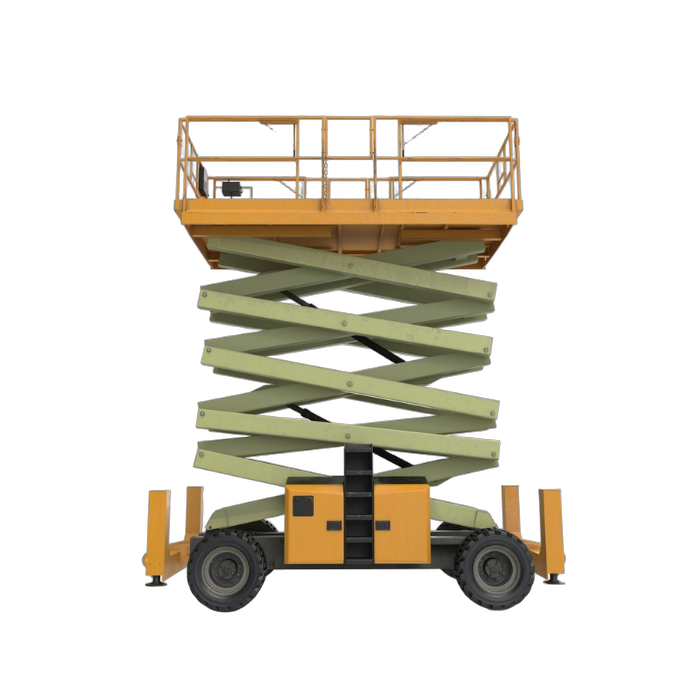

Key takeaways
- Purchase price: Electric scissor lifts cost $8,000-$35,000 new; diesel/rough terrain models cost $25,000-$60,000+ (2026 AUD).
- Hire rate: $250-$500/week for electric indoor models; $400-$800/week for diesel rough terrain - rates vary by state and hire period.
- Break-even point: Purchasing typically beats hiring at 16-24 weeks of use per year for electric models and 12-20 weeks for diesel - below that, hiring is cheaper.
- Annual running cost (owned): Typically $2,000-$6,000/year covering inspections, maintenance, insurance and battery or fuel costs.
- Hidden hire costs: Transport ($200-$600 per delivery/pickup), damage waivers ($50-$150/week) and fuel surcharges typically add around 20-30% to the advertised weekly rate depending on supplier and location.
- Compliance: Owned scissor lifts require annual competent person inspection per AS 1418.10, operator training (not a High Risk Work Licence for under 11m), and a plant risk assessment under WHS Regulations 2017.
- Electric and diesel scissor lifts are available from verified Australian suppliers on IndustrySearch.
Scissor lift running costs and hire vs buy break-even in Australia (2026)
Scissor lifts sit in a unique cost category for Australian operations: they are expensive to own but also expensive to hire frequently. The hire vs buy decision is the first question most procurement managers need to answer, but the break-even calculation is routinely wrong because it compares the hire rate against the purchase price alone - ignoring insurance, annual inspections, battery replacement, transport costs on hire returns and compliance obligations on owned plant.
This guide models both pathways across electric and diesel scissor lifts so operations can build a complete cost model for internal approval. To compare purchase pricing from verified Australian suppliers, get quotes for scissor lifts on IndustrySearch.
Operations where this cost comparison matters most:
- Warehouses and distribution centres using scissor lifts for racking maintenance 2-4 days per week
- Construction and fit-out contractors with 3-6 month project cycles requiring working-at-height access
- Manufacturing facilities with overhead equipment needing periodic maintenance access
- Facility management teams maintaining multiple buildings with regular access requirements
Choose your cost pathway
Before modelling costs, confirm whether your usage pattern favours hire or purchase. Your pathway here sets the cost structure that follows.
Usage Pattern | Weeks/Year | Recommended Pathway |
|---|---|---|
Occasional (project-based, seasonal) |
1-12 |
Hire - purchase cost cannot be recovered at this utilisation |
Regular (weekly maintenance, ongoing access) |
16-30 |
Break-even zone - model both pathways against your specific usage |
Continuous (daily warehouse or factory use) |
30+ |
Purchase - hire costs exceed ownership cost within 12-18 months |
Hire suits you if your scissor lift need is project-based, seasonal or under 12 weeks per year. The all-in hire cost (rate + transport + damage waiver) is still cheaper than owning, insuring and maintaining a machine that sits idle for 40+ weeks.
Purchase suits you if the machine runs 16+ weeks per year and is available when needed without scheduling around hire availability. Ownership also avoids transport costs on every mobilisation and gives you control over maintenance and compliance scheduling.
Evaluate the key cost lines
With your pathway confirmed, these are the cost lines for each option.
Cost Line | Hire (per use) | Own (annual) |
|---|---|---|
Base rate / purchase |
$250-$800/week |
$8,000-$60,000 one-off |
Transport |
$200-$600 per delivery + pickup |
N/A (stored on-site) |
Damage waiver / insurance |
$50-$150/week |
$800-$2,000/year (plant insurance) |
Inspection |
Included in hire rate |
$300-$800/year (AS 1418.10 competent person inspection) |
Maintenance |
Included in hire rate |
$500-$2,000/year (battery, hydraulic fluid, tyres, electrical) |
Battery replacement (electric) |
N/A |
$2,000-$5,000 every 5-7 years |
Operator training |
$200-$400 per operator |
$200-$400 per operator (same requirement) |
Understand the full cost comparison (2026 prices)
Purchase price is only part of the picture - most hire vs buy comparisons fail because they miss the ownership overhead or undercount the hire extras. Here is the full breakdown.
Category | Price Range (AUD) | Typical Configuration |
|---|---|---|
Electric indoor new (6-8m platform height) |
$8,000-$20,000 |
Battery-powered, non-marking tyres, 230 kg platform capacity |
Electric outdoor new (10-14m) |
$18,000-$35,000 |
Deck extensions, outriggers, 350-450 kg capacity |
Diesel rough terrain new (10-18m) |
$25,000-$60,000+ |
4WD, levelling jacks, 500+ kg capacity |
Used/refurbished |
$5,000-$30,000 |
Inspect hydraulics, battery condition, structural welds, compliance tag |
Annual ownership cost (electric indoor) |
$2,000-$4,000/year |
Insurance, inspection, maintenance, battery charging |
Annual hire cost at 20 weeks (electric indoor) |
$7,000-$13,000/year |
Rate + transport + damage waiver for 20 weeks |
At 20 weeks of annual use on an electric indoor model, hiring costs $7,000-$13,000/year while owning costs $2,000-$4,000/year plus the original purchase. A $15,000 unit typically pays for itself in 2-3 years at this usage. For a scissor lift at $8,000-$60,000, get quotes for scissor lifts to compare purchase pricing from verified Australian suppliers.
Plan the asset (depreciation and financing)
The ATO effective life for mobile elevating work platforms is 10 years. Under diminishing value, the depreciation rate is 20%; prime cost is 10% per annum. The instant asset write-off threshold for 2025-26 is $20,000 - most electric indoor models fall within this; larger diesel units will need standard depreciation.
Scissor lifts typically retain 20-35% of purchase price at 8-10 years when regularly inspected and well-maintained. Hire-to-own arrangements are available from major hire companies (Kennards, Coates, JLG dealers) at $400-$1,200/month for operations wanting to convert hire spend to equity without a lump-sum purchase.
Evaluate suppliers
You are ready to go to market. Use this checklist to assess each supplier against the same criteria.
Factor | What to Ask |
|---|---|
Platform height and capacity |
What is the maximum platform height and rated load capacity for this model? |
Battery type and life |
What battery type is fitted and what is the expected replacement interval at my usage? |
Inspection support |
Do you provide annual competent person inspections or can you recommend a provider? |
Warranty |
What is covered - structural, hydraulic, electrical? Duration? |
Spare parts |
Are hydraulic seals, batteries and control components stocked in Australia? |
Operator training |
Do you provide or arrange operator training as part of the purchase? |
Hire-to-own |
Do you offer hire-to-own or operating lease arrangements? |
Delivery |
Is delivery included? What is the transport cost to my site? |
Used unit inspection |
For used units - has this machine had a current AS 1418.10 inspection and is the report available? |
Trade-in |
Do you offer trade-in on existing EWPs if I am upgrading? |
Frequently asked questions
At what usage level does buying a scissor lift become cheaper than hiring?
For electric indoor models, purchasing breaks even with hiring at approximately 16-24 weeks of use per year. A $15,000 electric model with $3,000/year in ownership costs pays for itself in 2-3 years compared to hiring at $350-$500/week all-in.
What are the compliance requirements for owning a scissor lift in Australia?
Owned scissor lifts require annual inspection by a competent person per AS 1418.10, a plant risk assessment under WHS Regulations 2017, and operator training. Scissor lifts under 11m platform height generally do not require a High Risk Work Licence, but operators must be trained and requirements should be confirmed with the relevant state WHS regulator. Also state WHS regulator confirmation is required for edge cases.
How much does scissor lift maintenance cost per year?
Annual maintenance costs $500-$2,000 for electric indoor models and $1,500-$4,000 for diesel rough terrain, covering hydraulic fluid, battery maintenance, tyre condition, electrical systems and structural inspection. Budget separately for the AS 1418.10 annual inspection at $300-$800.
What hidden costs should i include in a hire vs buy comparison?
On the hire side, transport ($200-$600 per delivery/pickup), damage waiver ($50-$150/week) and fuel surcharges add 20-30% to the advertised weekly rate. On the buy side, insurance ($800-$2,000/year), annual inspection ($300-$800) and battery replacement ($2,000-$5,000 every 5-7 years) are the most commonly missed items.
Does a scissor lift operator need a licence in Australia?
Scissor lifts with a working height under 11 metres do not require a High Risk Work Licence. All operators must be trained and assessed as competent by the PCBU. Boom-type EWPs above 11m do require a WP licence class - confirm with your state WHS regulator for platform heights near the threshold.
Summary
- Purchase breaks even with hiring at 16-24 weeks/year for electric and 12-20 weeks for diesel
- All-in hire cost is 20-30% above the advertised weekly rate once transport and damage waiver are added
- Annual ownership cost is $2,000-$6,000 covering insurance, inspection, maintenance and energy
- Compliance requires annual AS 1418.10 inspection and operator training - not a HRWL under 11m
- Hire-to-own arrangements convert hire spend to equity without a lump-sum purchase
- Used scissor lifts at $5,000-$30,000 are viable if the unit has a current inspection report
Don't waste time contacting suppliers individually. IndustrySearch gives you direct access to verified Australian scissor lift suppliers - where industrial buyers request and compare multiple quotes so they can buy with confidence.
- Get quotes for scissor lifts - contact multiple verified suppliers with a single enquiry
- Compare models - filter by platform height, power type and region
- Contact suppliers directly - speak to specialists who service your state
→ Get and compare scissor lift quotes now → https://www.industrysearch.com.au/buy/scissor-lift




-160x160-state_article-rel-cat.png)




-205x205.jpeg)
-205x205.jpeg)

