
Key takeaways
- New price range: Walk behind floor scrubbers in Australia cost $2,000–$15,000 depending on scrub width, tank capacity and battery type (2026 pricing).
- Scrub width is the primary sizing decision: 400–500 mm for retail and aged care; 500–700 mm for warehouses and manufacturing; 700–850 mm for large-format facilities.
- Wrong size wastes labour hours: A 430 mm machine cleaning a 3,000 m² warehouse takes 3–4 hours per clean. A 700 mm unit does the same area in under 2 hours - that labour gap costs $15,000–$25,000/year.
- Battery type affects shift coverage: Lead-acid gives 2–3 hours runtime; lithium-ion gives 3–5 hours with opportunity charging. Under-specifying battery forces mid-shift stops.
- Disc vs cylindrical brush: Disc suits general-purpose scrubbing on smooth floors. Cylindrical picks up debris while scrubbing - eliminating a separate sweep pass on rough or grouted floors.
- If your facility is under 1,500 m²: Walk behind is the correct specification. Above 3,000 m², compare TCO against a ride-on floor scrubber before committing.
How to spec a walk behind floor scrubber for your facility
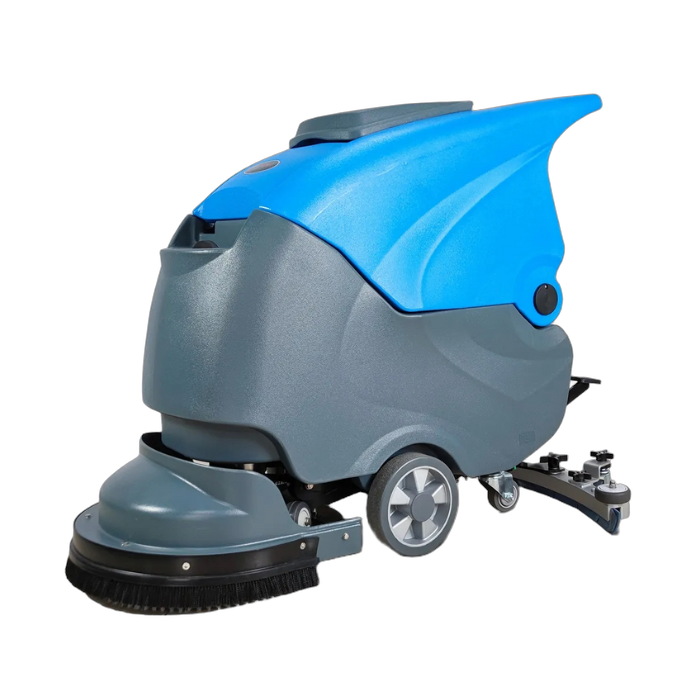
Walk behind floor scrubbers replace mop-and-bucket cleaning with a machine that scrubs, collects dirty water and dries the floor in a single pass. The specification error that costs Australian operations the most is undersizing: buying a compact unit for a facility that needs a mid-range machine, then absorbing 40–60% more labour hours per clean cycle for the life of the asset.
This guide covers the configuration, specification and supplier decisions that match a walk behind scrubber to your facility. If you are comparing models, get quotes for walk behind floor scrubbers to see current pricing from verified Australian suppliers.
Operations where walk behind floor scrubbers are the standard cleaning method include:
- Warehouses and distribution centres (500–5,000 m²)
- Manufacturing and food processing facilities
- Retail stores, shopping centres and showrooms
- Aged care, hospitals and healthcare facilities
- Schools, gyms and community centres
Choose your size by facility area
Before comparing brands or features, confirm which scrub width matches your floor area. This decision sets your cleaning time, labour cost and machine price bracket.
Machine Class | Scrub Width | Best For |
|---|---|---|
Compact | 350–450 mm | Retail, aged care, small offices under 1,000 m² |
Mid-range | 500–650 mm | Warehouses, manufacturing, food processing 1,000–3,000 m² |
Large | 700–850 mm | Large warehouses, distribution centres 3,000–5,000 m² |
If your facility is under 1,500 m², a compact or mid-range walk behind is the correct specification. Above 3,000 m² with daily cleaning, model the labour cost against a ride-on unit before committing to walk behind.
Disc brush: Single or twin rotating discs suit smooth sealed concrete, vinyl, tile and epoxy floors. Pads are interchangeable for scrubbing intensity - from soft daily maintenance to aggressive stripping.
Cylindrical brush: Counter-rotating brushes sweep and scrub simultaneously, collecting debris into a built-in tray. This eliminates a separate pre-sweep step on textured, grouted or rough concrete floors - saving 20–30 minutes per cleaning cycle on a 2,000 m² facility.
Evaluate the key specifications
With your size class confirmed, these specs determine whether a given model handles your floor type and shift pattern.
Specification | Typical Range | Buyer Consideration |
|---|---|---|
Solution tank capacity | 15–80 litres | Determines how far the machine cleans before refilling - 40 L covers roughly 1,500–2,000 m² |
Recovery tank capacity | 15–80 litres | Should match or exceed solution tank to avoid mid-cycle emptying |
Battery voltage | 24 V–36 V | Higher voltage extends runtime and brush motor power. 24 V is standard; 36 V suits heavy-duty or extended shifts. |
Brush pressure | 20–45 kg | Higher pressure needed for oil, grease and tyre marks in manufacturing and automotive environments |
Noise level | 60–72 dB | Aged care, hospitals and retail require sub-65 dB for daytime cleaning without disruption |
Traction drive | Self-propelled / manual push | Self-propelled is standard on units above 500 mm. Manual push adds operator fatigue on shifts over 1 hour. |
The most common mistake is specifying a manual-push machine for areas above 1,500 m². Operator fatigue on a 2-hour manual clean reduces scrubbing speed by 20–30% in the second hour, extending total cleaning time and increasing labour cost.
Understand the full cost breakdown (2026 prices)
Purchase price is only part of the cost - consumables, batteries and chemical represent a significant ongoing spend that varies by machine class and usage.
Category | Price Range (AUD) | Typical Configuration |
|---|---|---|
Compact (350–450 mm) | $2,000–$5,000 | Single disc, small tank, manual push or light traction |
Mid-range (500–650 mm) | $5,000–$10,000 | Disc or cylindrical, 40–60 L tanks, traction drive |
Large (700–850 mm) | $10,000–$15,000 | Twin disc or cylindrical, 60–80 L tanks, self-propelled |
Annual consumables | $800–$2,500 | Brushes/pads, squeegee blades, chemical, filters |
Battery replacement | $500–$2,500 | Lead-acid every 2–3 years; lithium 5–7 years |
A mid-range walk behind scrubber replacing daily mop-and-bucket cleaning on a 2,000 m² facility saves 1.5–2 hours of labour per clean. At $35–$45/hour cleaning labour rates in NSW and VIC, that is $12,000–$20,000/year in saved labour on a $7,000 machine - payback within 6–8 months. If you are within 3 months of purchasing, get quotes for walk behind floor scrubbers to compare delivered pricing.
Plan the asset - depreciation and financing
The ATO effective life for floor cleaning equipment is typically 5–7 years. Under diminishing value at 5 years, the annual rate is 40%. Most walk behind scrubbers fall within the $20,000 instant asset write-off threshold for eligible businesses, allowing full deduction in the year of purchase.
A $8,000 mid-range unit written off immediately under instant asset write-off delivers a net tax benefit of $2,000–$2,400 at the 25–30% company tax rate. For larger purchases, equipment rental at $150–$300/month provides an alternative with fully deductible payments.
Evaluate suppliers
You are ready to go to market. Use this checklist to assess each supplier against the same criteria.
Factor | What to Ask |
|---|---|
Demo on your floor | Can you demonstrate the machine on my actual floor type and conditions before I commit? |
Battery runtime | What is the actual runtime on a single charge at my scrub width and speed setting? |
Consumable pricing | What do brushes, pads and squeegee blades cost, and how often do they need replacing? |
Warranty | What does the warranty cover - motor, battery, tanks, squeegee - and for how long? |
Service and parts | Are spare parts stocked in Australia? What is your service turnaround time? |
Training | Is operator training included at delivery? Does it cover daily maintenance routines? |
Rental and trial | Do you offer short-term rental or a trial period to validate the machine on my floor? |
Chemical compatibility | What cleaning chemicals work with this machine, and do you supply them? |
HACCP compliance | For food facilities: does the recovery tank design meet HACCP hygiene standards? |
Trade-in | Do you accept trade-ins on existing cleaning equipment? |
Australian compliance requirements
- Floor scrubbers must comply with AS/NZS 3820 (Essential Safety Requirements for Electrical Equipment) and carry appropriate Australian compliance markings.
- WHS Regulations 2017 require that cleaning equipment is maintained in safe working condition. Operators must be trained in safe use, chemical handling and emergency procedures.
- Food processing environments require machines that meet HACCP hygiene standards - removable recovery tanks with easy-clean design and chemical compatibility documentation.
- Battery charging areas must comply with AS/NZS 3000 electrical standards. Lead-acid batteries generate hydrogen during charging and require ventilated charging locations.
Frequently asked questions
What scrub width do i need for a 2,000 m² warehouse?
A 500–650 mm machine covers 2,000 m² in approximately 1.5–2 hours. Below 500 mm extends cleaning time beyond 3 hours, creating a labour cost gap that exceeds the price difference between machine sizes within 6 months.
When should i choose cylindrical over disc brush?
When your floor has joints, grouting, textured concrete or regular loose debris. Cylindrical brushes sweep and scrub in one pass, eliminating a separate pre-sweep step that adds 20–30 minutes per cycle.
How quickly does a walk behind scrubber pay for itself vs mop and bucket?
On a 2,000 m² facility cleaned daily, a $7,000 mid-range unit saves 1.5–2 labour hours per clean at $35–$45/hour. Payback is typically 6–8 months; annual labour saving is $12,000–$20,000.
What maintenance does a walk behind scrubber need?
Daily: empty and rinse recovery tank, check squeegee blades, inspect brushes. Weekly: charge battery fully, clean solution filter. Brushes and pads last 100–300 hours depending on floor abrasiveness. See the floor cleaning equipment maintenance guide for seasonal procedures.
At what floor area should i consider a ride-on instead?
Above 3,000 m² with daily cleaning, a ride-on floor scrubber typically delivers lower cost per square metre due to faster coverage and reduced operator fatigue. Below 2,000 m², walk behind is more manoeuvrable and cost-effective.
What matters most
- Scrub width determines cleaning time and labour cost - undersizing is the most expensive specification error in this category.
- Mid-range units ($5,000–$10,000) cover 90% of warehouse and manufacturing cleaning needs.
- Payback against mop-and-bucket cleaning is typically 6–8 months on daily-clean facilities.
- Cylindrical brush eliminates a separate sweep pass on rough or grouted floors.
- Always request an on-site demo on your actual floor before committing to purchase.
Most buyers shortlist 2–3 machines after seeing demos on their own floor.
Do not waste time contacting suppliers individually. IndustrySearch gives you direct access to verified Australian walk behind floor scrubber suppliers - where industrial buyers request and compare multiple quotes so they can buy with confidence.
- Get quotes for walk behind floor scrubbers - contact multiple verified suppliers with a single enquiry
- Compare models - filter by scrub width, brush type and tank capacity
- Contact suppliers directly - speak to specialists who service your state
? Get and compare walk behind floor scrubber quotes now ?


-160x160-state_article-rel-cat.png)