
Key takeaways
Factor | Electric Tug | Electric Counterbalance Forklift |
|---|---|---|
Purchase price (new, AUD 2026) |
$3,500 – $60,000 |
$25,000 – $80,000+ |
Licence requirement |
None — training only |
LF class High Risk Work Licence |
Annual maintenance |
$300 – $1,200 |
$2,000 – $5,000 |
Lifting capability |
None — horizontal towing only |
1,500 – 8,000+ kg to 3–7 m |
Best replacement trigger |
Forklift never lifts above ground level |
Task requires stacking or dock-height loading |
5-year TCO (mid-range) |
$15,000 – $27,000 |
$50,000 – $90,000 |
When a forklift is doing a tug’s job — and costing you for it
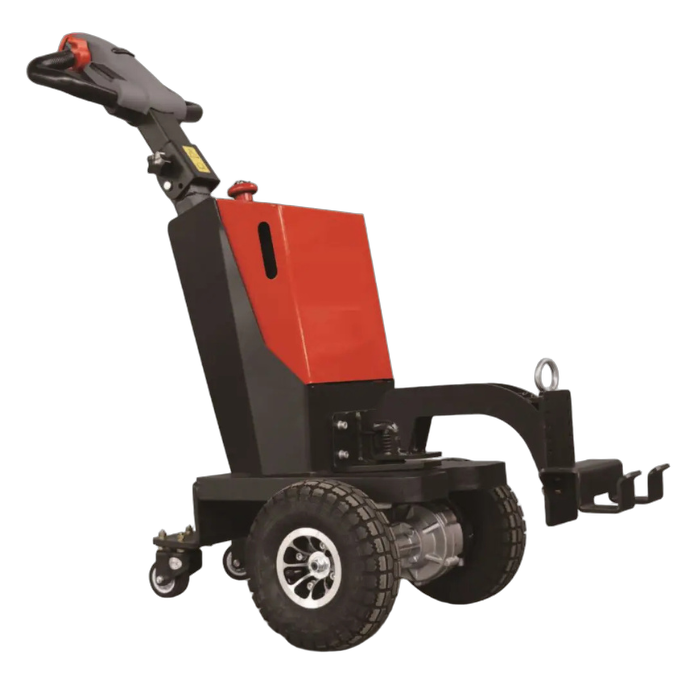
Across Australian warehouses, factories and hospitals, forklifts are routinely assigned to horizontal transport tasks they were never designed for — pulling trolley trains, shuttling bins between zones and towing loaded carts across flat floors. The forklift’s lifting capability goes unused, but its operating costs, licence requirements and pedestrian-zone risks stay fully in play. Electric tugs handle these horizontal-only tasks at a fraction of the cost and without requiring an LF-class High Risk Work Licence.
This guide sets out the specific use cases where an electric tug replaces a forklift, where it does not, and how the five-year cost comparison works. Compare electric tugs from verified Australian suppliers on IndustrySearch to benchmark pricing against your current forklift fleet costs.
Common operations where forklifts are being replaced by tugs:
- Warehouse zone-to-zone trolley and roll cage transport
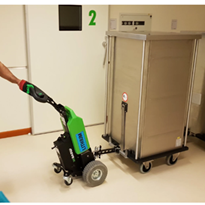
- Hospital linen, meal and equipment cart movement through corridors
- Manufacturing line feed — towing components between workstations
- Retail back-of-house stock replenishment from dock to floor
- Waste bin and skip movement to collection points
Identify which tasks can switch
Before costing anything, audit your forklift fleet tasks. The decision is binary: if the forklift lifts or stacks, it stays. If it only tows or pushes loads at ground level, a tug replaces it.
Task Type | Forklift Required? | Tug Suitable? |
|---|---|---|
Stacking pallets onto racking |
Yes |
No |
Loading/unloading trucks at dock height |
Yes |
No |
Towing trolley trains between zones |
No |
Yes |
Moving loaded carts through corridors |
No |
Yes |
Pulling bins to waste collection points |
No |
Yes |
Towing heavy plant on flat ground |
No |
Yes (heavy-duty models) |
If more than 30% of a forklift’s shift hours are horizontal transport — that forklift is a replacement candidate. A mid-range electric tug ($8,000–$25,000) handles those hours at lower cost and frees the forklift for lifting tasks where it actually adds value.
If the forklift operates in a shared pedestrian zone — a tug immediately reduces your WHS exposure. Pedestrian-operated tugs give the operator full forward visibility, eliminating the blind-spot and speed risks that drive forklift incident rates in mixed-traffic areas.
Compare the operating specs
With your task audit complete, these are the specifications that determine whether the switch works operationally.
Specification | Electric Tug | Electric CB Forklift |
|---|---|---|
Horizontal towing capacity |
500 – 10,000+ kg |
2,000 – 6,000 kg (tow hitch rated) |
Lifting capability |
None |
1,500 – 8,000+ kg to 3–7 m |
Operator licence |
None (training required) |
LF class HRWL |
Turning radius |
800 – 1,600 mm |
2,000 – 3,500 mm |
Operating noise |
Under 65 dB |
65 – 80 dB |
Pedestrian zone suitability |
Full forward visibility, walking pace |
Restricted — blind spots, exclusion zones required |
Compare the full cost over 5 years (2026 prices)
Purchase price is only part of the picture — most cost models that get rejected at approval stage have missed the running cost layer. Here is a direct five-year comparison for a mid-range horizontal transport task.
Cost Category | Electric Tug (mid-range) | Electric CB Forklift |
|---|---|---|
Purchase price (new) |
$12,000 – $20,000 |
$35,000 – $60,000 |
Annual maintenance |
$500 – $1,000 |
$2,500 – $5,000 |
Operator licence / training |
$200–$500 (one-off training) |
$800–$1,500 per operator (HRWL) |
Energy cost (annual) |
$150 – $400 |
$600 – $1,500 |
5-year TCO estimate |
$15,000 – $27,000 |
$50,000 – $90,000 |
On a straight horizontal transport task, the tug delivers a 50–70% saving over five years compared to running a forklift for the same job. The saving widens further when you factor in reduced WHS incident risk and the ability to deploy any trained worker rather than licensed operators only. For a three-forklift fleet in a QLD distribution centre where one unit is towing-only, replacing that unit with a tug can save $25,000–$40,000 over five years. Request quotes from electric tug suppliers on IndustrySearch to run the comparison against your own fleet costs.
Decision framework — electric tug vs forklift
Decision Factor | Choose Electric Tug | Keep Forklift |
|---|---|---|
Lifting required |
No — all movement is at ground level |
Yes — loads need stacking or dock-height placement |
Operating environment |
Shared pedestrian zones, tight corridors, hospitals |
Designated forklift zones with exclusion barriers |
Operator availability |
Any trained worker can operate — no HRWL needed |
Licensed LF operators available on every shift |
Budget |
Under $25,000 for most applications |
$35,000+ justified by lifting requirement |
WHS priority |
Reducing manual handling and pedestrian-zone incidents |
Forklift-specific traffic management plan already in place |
Towing capacity needed |
Up to 10,000 kg — dedicated towing performance |
Under 6,000 kg towing is secondary to lifting tasks |
Noise and emissions |
Under 65 dB; suits hospitals, food production, retail |
Acceptable in industrial-only environments |
Evaluate suppliers
You are ready to go to market. Use this checklist to assess each electric tug supplier against the same criteria.
Factor | What to Ask |
|---|---|
On-site trial |
Will the supplier trial the tug on your actual loads and floors before purchase? |
Coupling compatibility |
Does the tug fit your existing trolleys and carts, or is a custom coupling required? |
Battery type and runtime |
Lithium-ion or lead-acid? Does the runtime cover your shift pattern? |
Forklift trade-in |
Will the supplier accept a forklift trade-in or help you broker the sale of the replaced unit? |
Training included |
Is operator training included in the purchase price, and does it meet WHS documentation requirements? |
Service coverage |
Where is the nearest service technician and what is the standard response time in your state? |
Spare parts |
Are batteries, wheels and couplings stocked in Australia or imported to order? |
Warranty terms |
What components are covered (motor, electronics, battery, frame) and for how long? |
IP rating |
If operating in food, pharma or wet environments — is the unit rated IP65? |
Hire and lease |
Is short-term hire or hire-to-own available to validate before a capital commitment? |
Frequently asked questions
At what point does replacing a forklift with an electric tug pay for itself?
On a horizontal-only task, a mid-range electric tug at $12,000–$20,000 pays for itself within 12–18 months when you account for avoided forklift maintenance, energy costs and HRWL training — plus the freed forklift can be redeployed to lifting tasks where it generates more value.
Can an electric tug tow the same weight AS a forklift?
In most cases, yes. Heavy-duty electric tugs tow up to 10,000 kg or more — well beyond the tow hitch rating of most counterbalance forklifts at 2,000–6,000 kg. The tug is purpose-built for horizontal towing; the forklift treats it as a secondary function.
Do i still need a forklift if i buy an electric tug?
Yes, if any task on your site requires lifting, stacking or dock-height loading. The tug replaces the forklift only on horizontal transport tasks — it does not eliminate the need for a forklift where lifting capability is required.
What are the WHS advantages of switching to a tug?
Pedestrian tugs operate at walking pace with full forward visibility, eliminating the blind-spot and speed risks inherent in forklift operations. They also remove the manual handling strain of pushing and pulling heavy loads — the leading cause of musculoskeletal injury claims in Australian workplaces.
What is the typical lifespan comparison between the two machines?
An electric tug lasts 8–12 years with battery replacement every 3–8 years depending on chemistry. An electric counterbalance forklift lasts 10–15 years but carries significantly higher annual maintenance and battery replacement costs across that period.
Summary
- If the forklift never lifts above ground level, a tug does the same job at 50–70% lower five-year cost
- No HRWL required for tugs — any trained worker can operate, reducing labour bottlenecks
- Mid-range tugs at $8,000–$25,000 handle most warehouse and manufacturing horizontal transport tasks
- Tugs suit shared pedestrian zones where forklifts create WHS risk — full forward visibility at walking pace
- Forklifts remain necessary wherever lifting, stacking or dock-height loading is required
- Audit forklift fleet hours to identify towing-only tasks — that is your replacement opportunity
Ready to source your electric tug?
Don’t waste time contacting suppliers individually. IndustrySearch gives you direct access to verified Australian electric tug suppliers — compare models, specs and pricing in one place, then request quotes from suppliers best matched to your operation.
- Compare models — filter by capacity, configuration and region
- Request quotes — contact multiple verified suppliers with a single enquiry
- Contact suppliers directly — speak to specialists who service your state
→ Compare Electric Tugs on IndustrySearch Now →





-205x205.jpg)