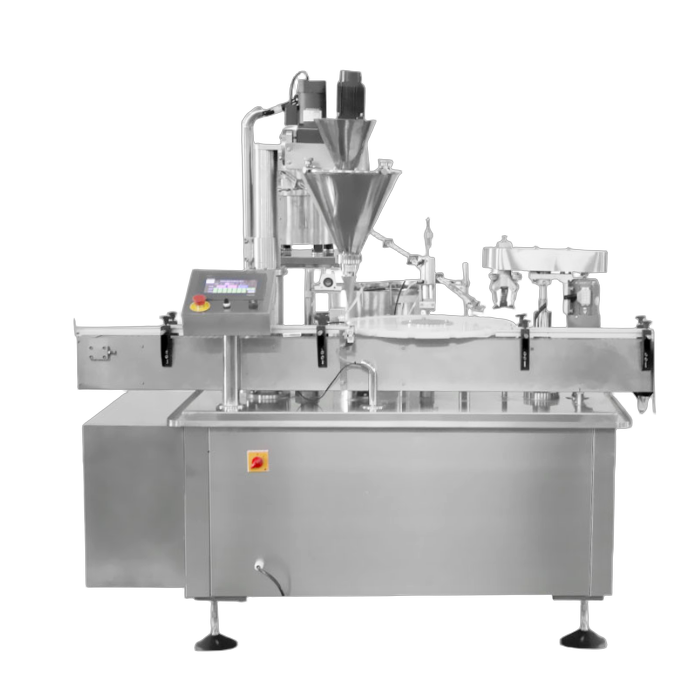

Key takeaways
- Purchase price ranges from $8,000 for an entry semi-automatic auger filler to $250,000+ for a fully automated net weight line (AUD 2026).
- Annual running costs: $4,500-$16,000 including maintenance, tooling, and consumables - most cost models submitted for approval miss at least two of these line items.
- Auger tooling sets cost $800-$3,500 each - operations with 5+ active SKUs should model tooling as a significant recurring cost, not a one-off.
- Five-year TCO for a mid-range automatic auger filler: $90,000-$130,000 including purchase, maintenance, tooling, and consumables.
- ATO effective life: 10 years - diminishing value rate 20%, prime cost rate 10%.
- Entry semi-automatic systems at $8,000-$18,000 fall within the $20,000 instant asset write-off threshold for the 2025-26 financial year.
- Hire-to-own available from approximately $650/month for a $25,000 system over 48 months - appropriate where production volume is unproven.
- Unplanned downtime is the largest hidden cost variable - parts sourced from overseas carry 3-7 day lead times; local service availability determines real-world exposure.
Powder filling machine costs in Australia: What you actually need to budget
Powder filling equipment purchases regularly get stalled or revised at approval stage because the submitted cost model covers purchase price only. Running costs - tooling sets per SKU, annual maintenance, consumables, and unplanned downtime - add 40-80% to total cost of ownership over five years on a mid-range system. Getting the full picture into your approval submission is what this guide is for. If you are still at configuration selection stage, start with the powder filling machine buying guide first, then return here to model the full cost.
This guide is for production managers and procurement leads building cost models for capital approval, finance applications, or supplier briefings. It covers purchase price tiers, all recurring cost lines, depreciation, and financing options for the Australian market. Get quotes for powder filling machines on IndustrySearch to compare supplier pricing against these benchmarks. Operations carrying this cost across sectors include:
- Food and beverage manufacturers running multiple powder SKUs - protein, flour, spice, coffee, and dairy
- Nutraceutical and supplement producers with high SKU counts and frequent changeovers
- Agricultural chemical and fertiliser producers filling bulk free-flowing products
- Contract packagers needing to model per-run costs across client SKUs
- Pharmaceutical and compounding operations building GMP-compliant line budgets
Confirm your system type - costs vary significantly by configuration
Before modelling any cost, confirm which system type you are operating or planning to purchase. Your configuration sets your maintenance schedule, tooling load, and service contract pricing for the next decade.
System Type | Key Cost Driver | Annual Cost Range |
|---|---|---|
Entry semi-automatic auger filler |
Seal and auger flight replacement |
$1,500-$4,500/year |
Mid-range automatic auger filler |
Tooling sets, servo maintenance, PM service |
$4,000-$9,000/year |
High-spec multi-head auger system |
Multi-head tooling, CIP consumables, PLC calibration |
$8,000-$16,000/year |
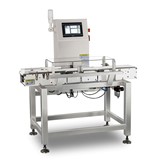
Net weight filling line |
Load cell calibration, NMI re-verification, reject system service |
$6,000-$18,000/year |
Running a high-spec multi-head system at 60+ fills/min on a food line means CIP consumables and multi-head tooling sets are your largest annual cost lines - not the machine service itself. Model these against your actual SKU count before finalising the budget.
Running a net weight line adds NMI re-verification costs that auger filler operators do not carry - typically $1,200-$2,500/year depending on state. Factor this as a fixed annual compliance cost in your model.
The key cost specifications
With your system type confirmed, these are the specifications that determine how much you will spend annually - not just what the machine can do, but what it costs to keep it running.
Specification | Typical Range | Cost Implication |
|---|---|---|
Active SKU count |
1-20+ SKUs |
Each SKU requiring a dedicated tooling set adds $800-$3,500 to capital cost - model this before purchase |
Daily throughput (fills/min) |
5-120 fills/min |
Higher throughput accelerates wear on seals, auger flights, and bearings - increases PM service frequency |
Product abrasiveness |
Low to high |
Abrasive powders (minerals, fertilisers, some pharma) double or triple auger flight wear rate vs food powders |
CIP / WIP requirement |
Manual, semi-auto, full CIP |
Full CIP adds $800-$2,000/year in cleaning chemical and water costs but saves 2-4 hours changeover labour per run |
Service contract type |
Breakdown only vs full PM |
Full PM contracts cost 30-50% more per year than breakdown-only but reduce unplanned downtime risk significantly |
Parts origin |
Local stock vs imported |
Imported parts carry 3-7 day lead times - each day of unplanned downtime on a mid-volume line costs $2,000-$8,000 in lost output |
Full cost breakdown (2026 prices)
Purchase price is only part of the picture - most cost models that get rejected at approval stage have missed the running cost layer. Here is every line item.
Cost Category | Price Range (AUD) | Notes |
|---|---|---|
Entry semi-automatic auger filler |
$8,000-$18,000 |
Benchtop, single-head, 304 SS, manual container placement |
Mid-range automatic auger filler |
$25,000-$65,000 |
Single-head, auto conveyor, servo-controlled, 316L SS |
High-spec multi-head auger system |
$80,000-$150,000 |
Twin or quad-head, CIP, 60-120 fills/min, touchscreen PLC |
Net weight filling line |
$45,000-$250,000+ |
NMI-verified load cells, integrated reject system |
Used / refurbished system |
$5,000-$40,000 |
Inspect tooling, seals, control board, and calibration history before purchase |
Installation and commissioning |
$2,000-$8,000 |
Often excluded from quoted machine price - confirm before signing |
Annual maintenance (PM service) |
$2,500-$8,000 |
Seals, bearings, auger flights, calibration - frequency driven by throughput |
Auger and tube tooling set |
$800-$3,500 per set |
One set per active SKU - replace every 2-4 years depending on product abrasiveness |
NMI re-verification (net weight lines) |
$1,200-$2,500/year |
Mandatory for legal-for-trade applications - varies by state |
Power consumption |
$600-$2,500/year |
0.5-3 kW per operating hour depending on system size and automation level |
Five-year TCO on a mid-range automatic auger filler purchased at $45,000 typically runs $90,000-$130,000 all-in - adding installation, five years of maintenance, tooling for a 5-SKU operation, and power. The single largest variable is tooling cost for high-SKU operations: a contract packager running 10 active SKUs will spend $15,000-$35,000 on tooling over five years on top of standard maintenance. Downtime risk is the second major variable - a single unplanned stoppage requiring overseas parts costs $6,000-$20,000 in lost output and repair at mid-volume throughput rates. For a mid-range automatic auger filler at $25,000-$65,000, get quotes for powder filling machines to compare service contract inclusions and parts availability before committing.
Plan the asset - depreciation and financing
The ATO effective life for powder filling machinery is 10 years - diminishing value rate 20%, prime cost rate 10%. Entry semi-automatic systems at $8,000-$18,000 fall within the $20,000 instant asset write-off threshold for the 2025-26 financial year and can be fully expensed in year of purchase. All other tiers depreciate under standard diminishing value. Residual value at 8-10 years is typically 10-20% of purchase price for maintained systems with documented service records.
Hire-to-own structures are available from approximately $650/month for a $25,000 system over 48 months. Operating leases suit operations where production volume is unproven or where capital preservation is a priority during line commissioning - monthly payments are predictable and the asset stays off the balance sheet. For a broader view of filling equipment financing structures, the filling machine price guide covers lease vs buy considerations across filling equipment categories.
Evaluate suppliers on cost
You are ready to go to market. Use this checklist to assess what each supplier includes and excludes from their quoted price.
Factor | What to Ask |
|---|---|
Installation inclusions |
Is installation, commissioning, and operator training included in the quoted price or charged separately? |
Service contract scope |
Does the contract include preventive maintenance visits, parts, and labour - or call-out only? |
Tooling cost per SKU |
What is the cost of each additional tooling set, and how many are included in the machine price? |
Parts availability |
Are wear parts stocked in Australia - and what is the lead time for seals, auger flights, and bearings? |
Warranty scope |
Does the warranty cover labour and parts? What is excluded, and is an extended warranty available? |
NMI verification cost |
For net weight systems: what is the annual re-verification cost and who arranges it? |
Service response time |
What is the guaranteed response time for a breakdown - same day, next day, or 48 hours? |
Tooling replacement cycle |
What is the expected tooling life at your throughput and product type - and what triggers replacement? |
Finance options |
Do they offer or facilitate hire-to-own, operating lease, or equipment loan arrangements? |
Used machine history |
If buying used: what is the service history, tooling condition, and remaining calibration validity? |
Frequently asked questions
What is the total cost of ownership for a powder filling machine over five years?
A mid-range automatic auger filler purchased at $45,000 typically reaches $90,000-$130,000 over five years once installation, maintenance, tooling, and power are included. High-SKU operations and sites dependent on imported parts will sit at the upper end of this range.
What running costs are most commonly missed in powder filling machine cost models?
Tooling sets at $800-$3,500 per SKU and NMI re-verification costs for net weight lines are the two items most frequently absent from initial approval submissions. Installation and commissioning at $2,000-$8,000 is the third - it is routinely excluded from supplier quotes and appears as a surprise line item at purchase order stage.
How does SKU count affect the five-year cost of a powder filling machine?
Each active SKU requiring a dedicated tooling set adds $800-$3,500 to capital cost plus replacement cost every 2-4 years depending on product abrasiveness. A 10-SKU operation will spend $15,000-$35,000 on tooling alone over five years - more than the cost of an entry semi-automatic machine.
When does hire-to-own make more financial sense than outright purchase for powder filling equipment?
Hire-to-own is the correct structure when production volume is unproven - new lines, new SKUs, or contract packaging operations where client volume commitments are short-term. It converts a capital outlay of $25,000-$150,000 into a predictable monthly cost of $650-$3,500 and preserves cash flow during the validation and ramp-up phase.
What is the downtime cost risk for an Australian powder filling operation?
Each day of unplanned downtime on a mid-volume line costs $2,000-$8,000 in lost output - and parts sourced from overseas carry 3-7 day lead times. WA and QLD operations face the highest exposure; confirm local parts stock and service technician location with every supplier before shortlisting.
Summary
- Five-year TCO on a mid-range automatic auger filler is $90,000-$130,000 - purchase price alone represents less than half of this figure
- Tooling cost is the largest variable in TCO for multi-SKU operations - model $800-$3,500 per active SKU plus replacement every 2-4 years
- Installation and commissioning at $2,000-$8,000 is routinely excluded from supplier quotes - always confirm what is in the quoted price
- NMI re-verification at $1,200-$2,500/year is a fixed annual compliance cost for net weight lines - not optional
- Local parts availability and service technician location are the biggest downtime risk factors - confirm both before shortlisting any supplier
- Entry semi-automatic systems at $8,000-$18,000 qualify for the instant asset write-off threshold in 2025-26 - factor this into the approval submission
Don't waste time contacting suppliers individually. IndustrySearch gives you direct access to verified Australian powder filling machine suppliers - where industrial buyers request and compare multiple quotes so they can buy with confidence.
- Get quotes for powder filling machines - contact multiple verified suppliers with a single enquiry
- Compare models - filter by fill system type, capacity, and region
- Contact suppliers directly - speak to specialists who service your state
→ Get and compare powder filling machine quotes now → https://www.industrysearch.com.au/buy/powder-filling-machine