
Key takeaways
| Factor | Guidance |
|---|---|
| Manual bin lifter price (AUD, 2026) | $1,500–$4,000 for basic hydraulic lift-and-tip units |
| Electric bin lifter price (AUD, 2026) | $5,000–$15,000 depending on capacity and tip height |
| Forklift-mounted tipper attachment (AUD, 2026) | $2,000–$6,000 for hydraulic fork-mounted models |
| Capacity range | 30 kg (countertop tippers) to 500 kg+ (industrial bin lifters) |
| Primary selection factor | Bin weight, bin type (wheelie bin, skip, IBC) and tipping destination |
| Key compliance | WHS Act 2011, AS 1418 (cranes and hoists), manual handling Code of Practice |
| Typical upgrade trigger | Manual bin emptying creates musculoskeletal injury risk or slows throughput |
→ Need to compare bin lifter suppliers? Compare bin lifters on IndustrySearch
Who this guide is for
Bin lifters and tippers mechanise the process of lifting, rotating and emptying bins into hoppers, skips, machines or waste compactors. They replace manual handling — a leading cause of workplace musculoskeletal injuries across Australian warehouses, food processing plants and manufacturing facilities.
This guide is for operations managers, WHS officers and procurement leads sourcing bin lifting or tipping equipment for industrial, food production or waste management applications in Australia.
Types of bin lifters & tippers
| Type | Capacity | Power Source | Best For |
|---|---|---|---|
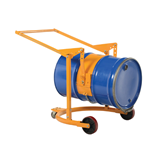
| Manual hydraulic bin lifter | 30–150 kg | Hand-pump hydraulic | Low-volume waste emptying, kitchens, small workshops |
| Electric bin lifter (standalone) | 80–300 kg | Battery or mains electric | Warehouses, food processing, repeated daily emptying cycles |
| Electric bin tipper (high-tip) | 100–500 kg+ | Electric motor with hydraulic ram | Tipping into hoppers, compactors, elevated machines |
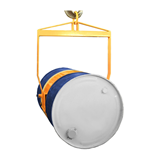
| Forklift-mounted bin tipper | 200–500 kg | Forklift hydraulics | Sites already running forklifts; large skip or IBC tipping |
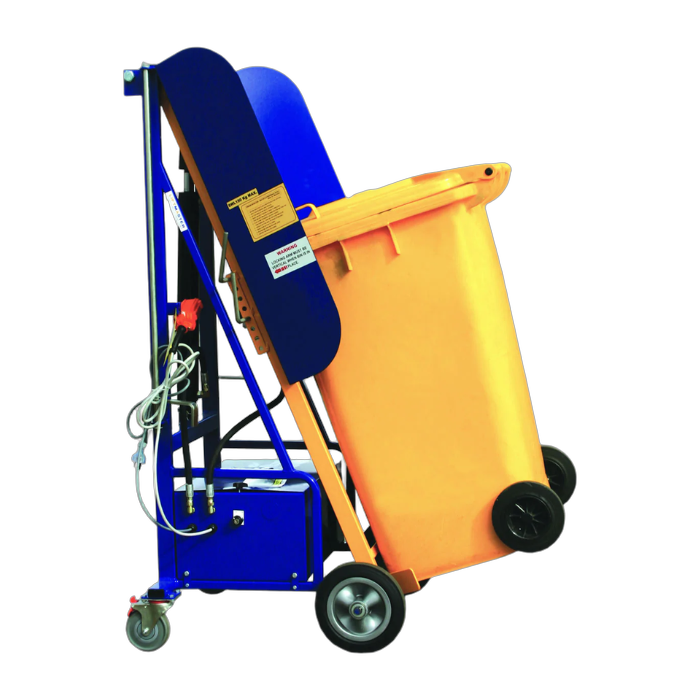
| Wheelie bin lifter (MGB lifter) | 60–240 L bins (up to ~120 kg) | Electric or pneumatic | Standard 120 L / 240 L wheelie bin emptying into skips or compactors |
Manual hydraulic bin lifters suit low-frequency applications where powered equipment isn’t justified — occasional bin emptying in kitchens, small retail back-of-house or workshops. They require physical effort to pump but eliminate overhead lifting.
Electric standalone bin lifters are the workhorse category. Battery-powered models offer mobility across a facility; mains-powered units deliver continuous duty at a fixed station. Most food processing and warehouse operations land here.
High-tip electric bin tippers handle heavier loads and tip to greater heights — typically 1,500–2,500 mm — making them the choice for emptying into elevated hoppers, compactors or production machinery.
Forklift-mounted tippers are cost-effective add-ons for sites already operating forklifts. The attachment clamps onto the forks and uses the forklift’s hydraulics to tip. Best suited for large skip bins and IBCs rather than standard wheelie bins.
Key specifications to compare
| Specification | Typical Range | Buyer Consideration |
|---|---|---|
| Safe working load (SWL) | 30–500 kg | Must exceed heaviest loaded bin weight including contents |
| Tip height | 900–2,500 mm | Measure the lip height of your hopper, compactor or machine inlet |
| Tip angle | 135°–180° | 180° (full inversion) needed for sticky or wet waste; 135° sufficient for dry product |
| Bin compatibility | MGB 120/240 L, skip bins, IBCs, custom bins | Confirm cradle or clamp fits your exact bin dimensions |
| Cycle time | 15–45 seconds (electric); 30–90 seconds (manual) | Critical for production-line applications where bins queue |
| Construction material | Mild steel (powder-coated) or 304/316 stainless steel | Stainless mandatory for food, pharmaceutical and washdown environments |
| IP rating | IP54–IP66 | IP65+ required for washdown areas in food and beverage facilities |
Costs in Australia (2026)
| Category | Price Range (AUD) | Typical Configuration |
|---|---|---|
| Manual hydraulic bin lifter | $1,500–$4,000 | Hand-pump, 100–150 kg SWL, mild steel |
| Electric bin lifter (standard) | $5,000–$10,000 | Battery-powered, 150–250 kg SWL, powder-coated steel |
| Electric high-tip bin tipper | $10,000–$20,000 | Hydraulic ram, 300–500 kg SWL, 2,000+ mm tip height |
| Stainless steel (food-grade) | $12,000–$25,000+ | 304 or 316 SS, IP65+, washdown-rated for food/pharma |
| Forklift-mounted tipper attachment | $2,000–$6,000 | Hydraulic fork-mount, 200–500 kg, fits standard forks |
Total cost of ownership extends beyond purchase price. Budget for annual servicing ($300–$800 per unit), hydraulic seal replacement every 2–4 years, and battery replacement on electric models every 3–5 years ($500–$1,500). Stainless steel models carry a 40–60% premium over mild steel equivalents but eliminate corrosion-related downtime in wet environments.
→ Request quotes from verified bin lifter suppliers on IndustrySearch
How to choose the right bin lifter or tipper
Step 1: Identify your bin type and maximum loaded weight. Measure the bin dimensions and weigh the heaviest loaded bin you’ll process. The lifter’s SWL must exceed this figure with margin — most manufacturers recommend a 20% safety buffer above maximum expected load.
Step 2: Measure the tipping destination height. The lip height of the hopper, compactor or machine inlet determines the minimum tip height you need. Add 100–200 mm clearance above the lip to allow clean discharge without spillage.
Step 3: Assess duty cycle and frequency. If you’re emptying bins fewer than 10 times per day, a manual hydraulic lifter may be sufficient. Beyond 10–15 tips per shift, electric models eliminate operator fatigue and maintain consistent cycle times.
Step 4: Check environment requirements. Wet areas, food zones and pharmaceutical facilities require stainless steel construction and IP65+ ratings. General warehouse and manufacturing environments can use powder-coated mild steel at significantly lower cost.
Step 5: Decide between standalone and forklift-mounted. If your site already runs forklifts and you need to tip large skip bins or IBCs, a fork-mounted attachment is cheaper and leverages existing equipment. Standalone electric lifters are better for wheelie bins and fixed-station operations.
Australian compliance & safety requirements
Bin lifters used in Australian workplaces must comply with the Work Health and Safety Act 2011 and the model Code of Practice for Hazardous Manual Tasks. Employers have a duty to eliminate or minimise manual handling risks — bin lifters are a direct engineering control under this framework.
Units classified as hoists or lifting devices must comply with AS 1418 (Cranes, hoists and winches). Forklift-mounted tippers fall under the same licensing requirements as the host forklift — operators must hold a current high-risk work licence (HRW) for forklift operation issued by the relevant state regulator (e.g. SafeWork NSW, WorkSafe Victoria).
Food-grade bin lifters should meet HACCP zone requirements and use materials compliant with AS 4674 (Construction of equipment for the food industry). Regular inspection and maintenance records must be kept as per the WHS Regulations to demonstrate ongoing compliance.
Supplier comparison checklist
| Factor | What to Ask |
|---|---|
| SWL and tip height | Does the unit’s rated capacity and maximum tip height match your application? |
| Bin compatibility | Has the supplier confirmed fitment for your specific bin type and dimensions? |
| Construction material | Is stainless steel available if your environment requires washdown or food-grade certification? |
| Safety features | Does the unit include bin clamping, safety gates, tip-lock and emergency stop? |
| Warranty | What is the structural warranty period? Are hydraulics and electrics covered separately? |
| Installation | Is installation included? Does the unit require floor mounting or can it operate freestanding? |
| Servicing and parts | Does the supplier offer servicing in your state? What are lead times for spare parts? |
| Custom configurations | Can the supplier modify cradle size, tip height or tip angle for non-standard bins? |
| Lead time | What is the delivery lead time? Are ex-stock units available or is it build-to-order? |
| Compliance documentation | Can the supplier provide certificates of conformance, load test certificates and compliance statements? |
Frequently asked questions
What size bin lifter do i need?
Size is determined by two factors: the loaded weight of the heaviest bin you’ll process and the height of the tipping destination. Weigh your bins at peak load and measure your hopper or compactor lip height to determine the minimum SWL and tip height required.
Can i use a bin lifter in a food processing environment?
Yes — provided the unit is constructed from 304 or 316 stainless steel, rated IP65 or higher for washdown, and meets AS 4674 requirements. Standard powder-coated mild steel units are not suitable for direct food-contact zones.
Do i need a licence to operate a bin lifter?
Standalone bin lifters generally do not require operator licensing. However, forklift-mounted tippers require the operator to hold a current HRW forklift licence. All operators should receive site-specific training on the equipment as per WHS obligations.
How often do bin lifters need servicing?
Most manufacturers recommend annual servicing covering hydraulic seals, electrical connections, structural welds and safety interlocks. High-frequency operations — more than 50 tips per day — typically require six-monthly servicing.
What is the lifespan of an electric bin lifter?
Well-maintained electric bin lifters typically last 8–15 years. The hydraulic ram and battery are the primary wear items. Budget for battery replacement every 3–5 years and hydraulic seal kits every 2–4 years to maintain performance.
Compare bin lifters & tippers on IndustrySearch
Stop chasing individual suppliers. IndustrySearch connects you directly with verified Australian bin lifter and tipper suppliers — compare models, specs and pricing in one place.
- Compare manual, electric and forklift-mounted models by capacity, tip height and construction
- Request quotes from multiple verified suppliers with a single enquiry
- Speak directly with suppliers servicing your state
→ Compare Bin Lifters on IndustrySearch Now →