
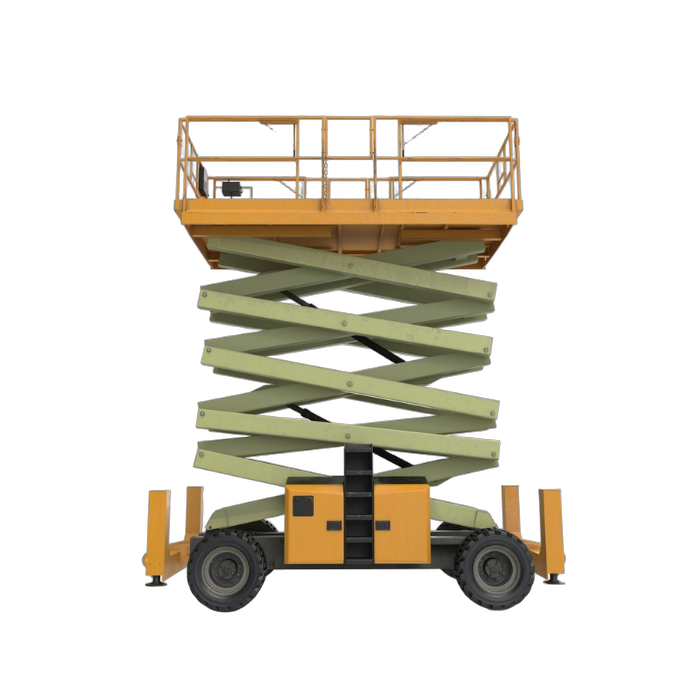

\Key takeaways
- Purchase price gap: Electric scissor lifts cost $8,000-$35,000 vs diesel at $25,000-$60,000+ (2026 AUD) - diesel costs 2-3x more at equivalent platform height.
- Running cost gap: Electric costs $1,500-$4,000/year to run (battery charging, maintenance, inspection); diesel costs $3,000-$6,000/year (fuel, filters, hydraulic servicing, inspection).
- Indoor vs outdoor: Electric is the only option for enclosed spaces - zero emissions, low noise (55-65 dB), non-marking tyres. Diesel is required for uneven terrain, steep grades and sites without charging infrastructure.
- Platform height range: Electric models reach 6-14m; diesel rough terrain models reach 10-18m+ with 4WD and levelling jacks for uneven ground.
- Battery life: Electric models run 4-6 hours per charge on a standard cycle - sufficient for a single shift. Multi-shift operations need overnight charging or a second battery pack ($2,000-$5,000).
- 5-year TCO at standard use: Electric indoor $18,000-$50,000 vs diesel rough terrain $40,000-$90,000 - but diesel serves sites that electric physically cannot access.
- Both electric and diesel scissor lifts are available from verified Australian suppliers on IndustrySearch.
Electric vs diesel scissor lift: Which power type fits your operation? (2026 comparison)
The electric vs diesel scissor lift decision is not primarily a cost question - it is a site access question. Electric models cannot operate on soft ground, steep grades or sites without power. Diesel models cannot operate indoors, in noise-restricted areas or in zones where emissions are prohibited. Most operations that get this wrong buy an electric model for versatility and then hire a diesel for outdoor jobs 6 times a year, or buy a diesel for coverage and pay $3,000-$6,000/year in running costs when 80% of their work is on flat warehouse floors.
This comparison guide puts both power types side by side on capability, cost, compliance and the decision factors that determine which one earns its place. To compare purchase pricing, get quotes for scissor lifts on IndustrySearch.
Operations where this comparison matters most:
- Construction and fit-out contractors working across indoor and outdoor sites
- Facility management teams with mixed building types (warehouses, car parks, external facades)
- Mining and resources maintenance teams operating on uneven ground in remote locations
- Event and staging companies setting up in venues with variable surface conditions
Compare the core differences
Before comparing costs, confirm which power type your primary work environment requires. The table below covers the capabilities that drive the decision.
Factor | Electric | Diesel |
|---|---|---|
Platform height |
6-14m |
10-18m+ |
Platform capacity |
230-450 kg |
350-680 kg |
Terrain capability |
Flat, hard surfaces only (concrete, asphalt, sealed floors) |
Uneven ground, gravel, compacted earth, slopes up to 5° |
Emissions |
Zero - suitable for indoor and enclosed spaces |
Exhaust emissions - outdoor use only |
Noise |
55-65 dB (quiet enough for occupied buildings) |
75-85 dB (hearing protection may be required) |
Run time |
4-6 hours per charge |
8-12 hours per tank (40-60L fuel capacity) |
Tyres |
Non-marking solid rubber |
Pneumatic rough terrain with aggressive tread |
Evaluate the key specifications
With the core differences clear, these are the specifications that determine which power type delivers better value for your specific operation.
Specification | Typical Range | Buyer Consideration |
|---|---|---|
Gradeability |
Electric 25%; Diesel 30-40% |
Diesel's higher gradeability matters on construction sites with ramps and slopes - electric stalls on loose surfaces |
Ground clearance |
Electric 75-100 mm; Diesel 200-350 mm |
Low clearance on electric models means kerbs, debris and uneven joints can ground the machine |
Transport weight |
Electric 1,500-4,000 kg; Diesel 3,500-8,000 kg |
Heavier diesel units need a tilt-tray truck for transport ($400-$800 per move) vs trailer for lighter electric units |
Deck extension |
0.9-1.5m rollout on most models |
Deck extensions increase horizontal reach but reduce rated capacity - check the load chart for combined height and extension |
Levelling jacks |
Standard on diesel; optional on large electric |
Auto-levelling jacks add $1,500-$3,000 to electric models but are necessary for outdoor use on uneven paving |
Compare the full cost (2026 prices)
Purchase price is only part of the picture. The table below models the full 5-year cost for each power type at equivalent working heights.
Category | Electric (10m) | Diesel (10m) |
|---|---|---|
New unit purchase |
$18,000-$30,000 |
$30,000-$50,000 |
Used/refurbished |
$8,000-$18,000 |
$15,000-$30,000 |
Annual energy/fuel |
$300-$600 (battery charging) |
$1,500-$3,000 (diesel at ~$2.00/L) |
Annual maintenance |
$500-$1,500 |
$1,000-$2,500 |
Annual inspection + insurance |
$1,100-$2,500 |
$1,300-$3,000 |
5-year TCO |
$28,000-$53,000 |
$49,000-$93,000 |
At equivalent 10m platform height, electric costs 40-50% less over 5 years. The cost gap is driven by fuel, maintenance complexity and higher insurance premiums on diesel units. For an electric model at $18,000-$30,000 or diesel at $30,000-$50,000, get quotes for scissor lifts to compare pricing from verified Australian suppliers.
Decision framework - electric vs diesel
Decision Factor | Choose Electric | Choose Diesel |
|---|---|---|
Primary work environment |
Indoor, warehouse, sealed floors, car parks |
Outdoor construction, uneven ground, remote sites |
Emissions requirement |
Enclosed or occupied spaces - zero emissions mandatory |
Open-air sites where exhaust is not a constraint |
Shift duration |
Single shift (4-6 hours) with overnight charging |
Multi-shift or remote sites with no charging infrastructure |
Platform height required |
Under 14m - electric covers most warehouse and building maintenance |
14m+ or heavy-load applications above 450 kg |
Budget priority |
Lowest TCO and simplest maintenance |
Site capability over cost - diesel goes where electric cannot |
Noise restriction |
Occupied buildings, hospitals, residential-adjacent sites |
Construction sites with standard noise management |
Evaluate suppliers
You are ready to go to market. Use this checklist to assess each supplier against the same criteria.
Factor | What to Ask |
|---|---|
Terrain suitability |
Can this model operate safely on the surface types at my primary work sites? |
Battery or fuel run time |
What is the real-world run time at my planned duty cycle and platform height? |
Warranty |
What is covered - structural, hydraulic, electrical, engine/battery? Duration? |
Service network |
Do you have mobile service technicians in my state for field repairs? |
Spare parts |
Are batteries, hydraulic seals and control modules stocked in Australia? |
Compliance support |
Do you provide AS 1418.10 annual inspections or recommend a provider? |
Transport |
Is delivery included? What vehicle is needed to transport this model? |
Operator training |
Do you provide or arrange operator competency training with purchase? |
Trade-in |
Do you accept trade-ins on existing EWPs? |
Finance |
Do you offer equipment finance, chattel mortgage or operating lease? |
Frequently asked questions
When should i choose a diesel scissor lift over electric?
Choose diesel when your work is primarily on uneven outdoor ground, soft surfaces, steep grades or remote sites without charging infrastructure. If any of your regular jobs involve gravel, compacted earth or slopes above 3°, electric models will not perform safely.
How much more does a diesel scissor lift cost to run per year?
Diesel costs $3,000-$6,000/year to run vs $1,500-$4,000 for electric at comparable usage. The gap is driven primarily by fuel ($1,500-$3,000/year at current diesel prices) and more complex engine servicing requirements.
Can an electric scissor lift be used outdoors?
Yes, on flat, hard surfaces such as sealed car parks, paved areas and concrete pads. Electric outdoor models with deck extensions and levelling jacks handle moderate outdoor conditions, but they cannot operate on soft ground, gravel or slopes above 3°.
What is the battery replacement cost on an electric scissor lift?
Battery replacement costs $2,000-$5,000 every 5-7 years depending on battery chemistry and charge cycle frequency. Lithium-ion options are entering the market at higher upfront cost but with longer cycle life and faster charging.
Do electric and diesel scissor lifts have different compliance requirements?
Both require annual AS 1418.10 competent person inspection and operator competency training under WHS Regulations 2017. Diesel models have additional requirements for exhaust emission management on enclosed or semi-enclosed sites and fuel storage compliance per AS 1940.
Summary
- Electric is the lower-cost, lower-maintenance option for indoor and flat-surface outdoor work
- Diesel is required for uneven terrain, steep grades and remote sites without power
- 5-year TCO at 10m platform height: electric $28,000-$53,000 vs diesel $49,000-$93,000
- The decision is driven by site access capability, not cost preference
- Operations with mixed indoor/outdoor work should consider owning electric and hiring diesel for outdoor-only jobs
- Both types require annual AS 1418.10 inspection and operator training - no HRWL under 11m
Don't waste time contacting suppliers individually. IndustrySearch gives you direct access to verified Australian scissor lift suppliers - where industrial buyers request and compare multiple quotes so they can buy with confidence.
- Get quotes for scissor lifts - contact multiple verified suppliers with a single enquiry
- Compare models - filter by platform height, power type and region
- Contact suppliers directly - speak to specialists who service your state
→ Get and compare scissor lift quotes now → https://www.industrysearch.com.au/buy/scissor-lift




-160x160-state_article-rel-cat.png)




-205x205.jpeg)
-205x205.jpeg)

